 Tue, Dec 10, 2024
Announcing the New Replit Assistant
Today on Replit, anyone can take their ideas and turn them into software — no coding required. For nearly a decade, Replit’s mission has been to bring coding to the next billion people. We’ve helped millions of people learn to code and made programming less intimidating. But now, thanks to our Agent and Assistant, our AI coding products, we’re taking a giant leap forward. You don’t need to learn coding to be a creator — you just need an idea. From local realtors in Cleveland to Japanese influencers to product managers at some of the world’s largest enterprises, people are building incredible things on Replit. We no longer need to limit ourselves to being users of software, we can all be creators. Today, we’re taking Replit Agent out of early access and officially launching it with groundbreaking updates that will radically expand who can create software. Let us show you what’s possible.
 Wed, Nov 13, 2024
Zero to MVP
Since joining Replit, I’ve faced a harsh truth—I’ve never written a line of code. As a UC Berkeley student studying business journalism, coding feels out of reach. I’ve had countless app ideas but would always hit the same wall: Who can build this for me? That’s until I discovered Replit. It's a platform that brings ideas to life fast—no technical background needed. Replit bridges the gap between creative vision and actual execution. Making Ideas Happen
 Mon, Nov 4, 2024
How we name things
What’s in a name? Well, a lot, but first and foremost: stress. Whether we’re naming our babies, pets, companies, or features, we tend to worry a lot about finding the perfect name. We know intuitively that a name will shape how something is perceived and even influence its direction going forward. And yet, this stress isn’t equally distributed. In business, people tend to think a lot about the names of the companies they’re building but leave each product and feature name up to whoever thinks of the best-sounding name first.
 Tue, Oct 8, 2024
From localhost to live
If you have a body, you are an athlete. Bill Bowerman, Co-founder, Nike The title "programmer" was always reserved for those who code. So it make sense that shipping software is synonymous with, well... writing code. But is the hardest part about shipping really learning to code? I wish. The hardest part(s) are everything that lives between localhost and live. Today, we're seeing a new class of builders—the AI native developer. These users have some technical prowess and build through clever use of the latest tools. But the problem was never just writing code. Despite lower friction to code, roadblocks still exist. Where, you ask?
 Mon, Aug 26, 2024
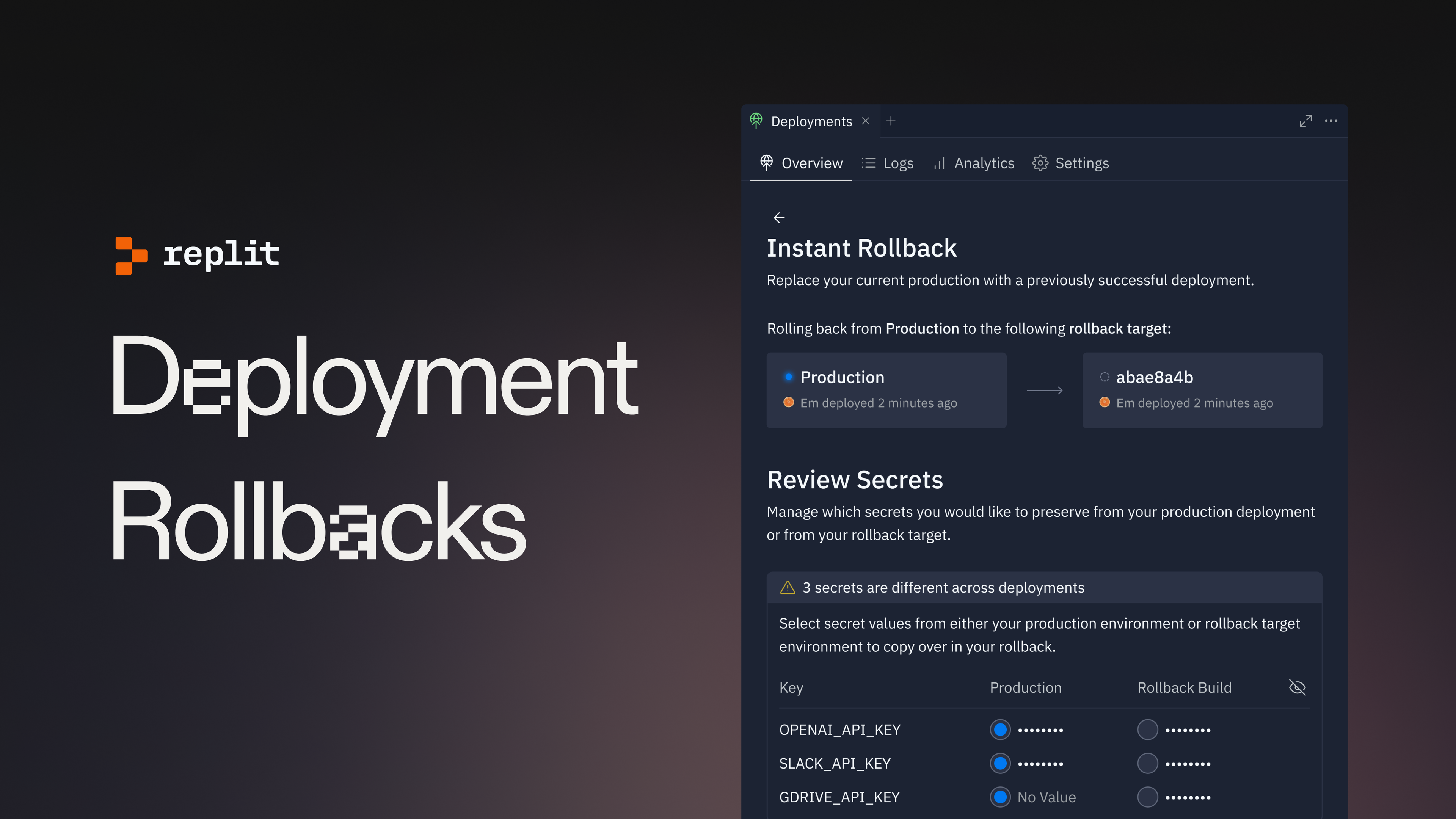
Introducing Deployment Rollbacks
Deployment rollbacks are a new feature that allow you to quickly and confidently version your deployments. Rollbacks allow you to restore a previous successful deployment in one click: fix a broken build or a typo in seconds. A quick tour Let’s explore the new additions to the deployment experience. Rollback activation
 Fri, Jul 19, 2024
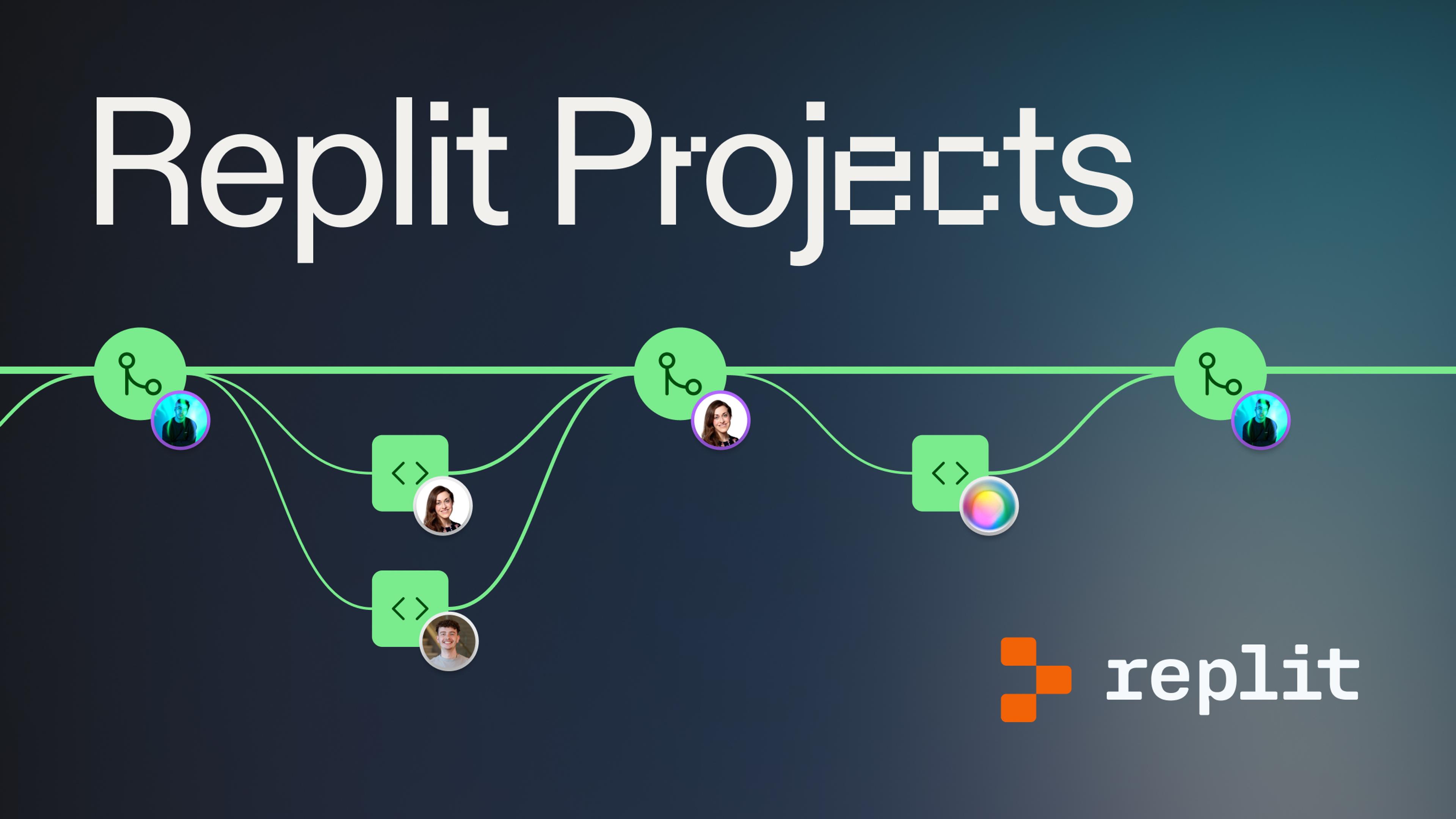
Introducing Replit Projects
We’re excited to announce Projects for Replit, a new way to collaborate with your team. This feature is in beta now, available to all Replit Teams customers. Projects let you maintain multiple versions of your team’s codebase and easily merge your changes together when you’re ready. Anyone on your team can “fork” (create a new copy of the code), make changes, preview what changed, and then merge those changes back into the main version with a few clicks. If you weren’t using Replit, it might take a new teammate hours to set up their local development environment, make their changes correctly, and get their code reviewed and merged. Why use Projects? As a team writing software, collaboration is important. Realtime coding or pair programming is useful, but sometimes you need your own space to work. If your whole team was working on their ideas in a realtime session at the same time, one person writing some invalid code would stop everyone else from being able to test their own code. And sometimes, you might want to test out an idea without knowing for sure if it’s the right approach, and be ready to scrap it if it doesn't work out.
 Tue, Jul 16, 2024
Introducing Replit Teams
In today's fast-paced work environment, using real-time collaboration tools like Google Docs and Figma comes naturally to most of us. As a result, we've come to expect a lot more from our tools. Yet, when it comes to building software, we often find ourselves stuck with tools built for a different era — tools that cause our teams to feel siloed, inefficient, and less collaborative overall. In decades past, the software development lifecycle looked like a rigid industrial process: product managers would hand off documents to designers, and designers would hand off mock-ups to engineers. Today, however, the process is much more fluid and cross-functional. Engineers contribute to design, product managers prototype, and designers code. Still, engineering tools have remained inaccessible to everyone except engineers, preventing meaningful contributions from other roles, and slowing everyone down. This led us to wonder: What would it look like to design software collaboration tools that truly meet the changing needs of 21st-century teams? Introducing Replit Teams Go from idea to software faster than ever before. Today, we’re announcing that Replit Teams is generally available and here to set a new standard for building software.
 Thu, May 2, 2024
Introducing Object Storage
We’re excited to announce Replit Object Storage, a fast and durable way to persist files and other unstructured data. Object Storage ensures your data is resilient against data loss and usable across the Replit workspace and Deployments. It handles any number of processes reading and writing simultaneously, enabling your application to seamlessly add compute power and scale to handle extra requests. Our goal with Object Storage was to deliver a solution that enables you to start reading and writing files from your application as quickly as possible. We’ve designed the system to require minimal configuration and work out-of-the-box in both the workspace and Deployments. Object Storage excels at storing large amounts of unstructured data (think lots of files with varying shapes and sizes). It’s ideal for: Storing media assets such as images Persisting files uploaded by users such as PDF documents Flexible data storage that doesn’t require configuring a database such as CSV and JSON files
 Fri, Apr 5, 2024
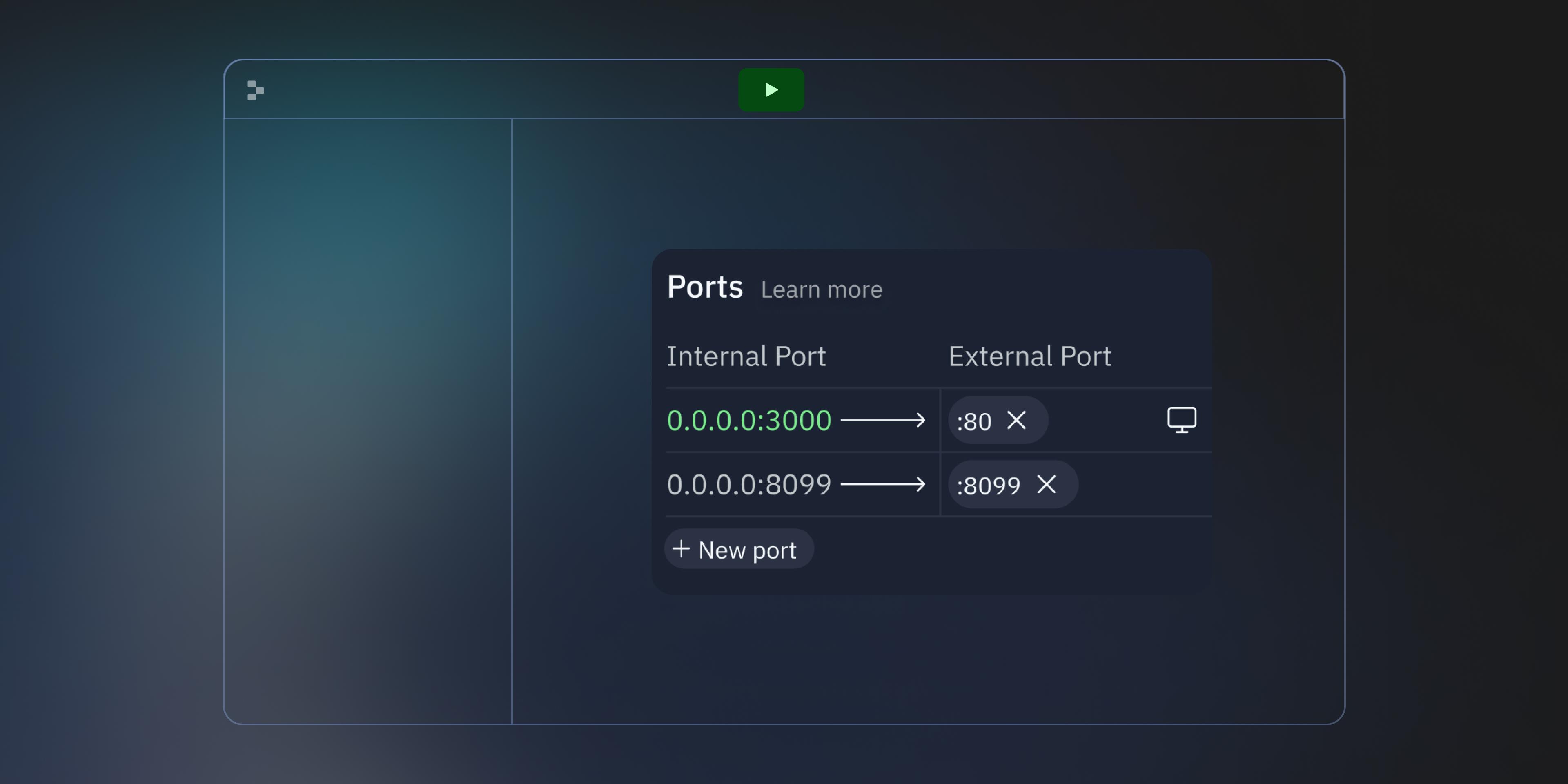
Advanced port configuration
We recently spent a few months making ports easier to work with on Replit, so you can develop more complex apps predictably. What are ports? When a computer receives a TCP/UDP request, ports define which program that request should route to. (If you need a more basic explanation of TCP ports, start here). On a normal computer, you only have one layer of ports: your programs define a port that they listen to, and when traffic hits that port on your computer from the internet, it gets routed to the appropriate process. Some protocols have defined standard ports — for example, Simple Mail Transfer Protocol Secure (SMTPS), the email protocol, generally listens on port 587, and most web servers listen on either port 80 (HTTP, unencrypted) or port 443 (HTTPS, encrypted). You can think of ports like mailboxes. Imagine those big mailrooms in skyscrapers that ensure the mail lands in the right mailbox — the mail is the data being sent and received, and the mailboxes are the ports.
 Wed, Apr 3, 2024
Replit Developer Day recap
On April 2nd, we hosted our second annual Developer Day live from San Francisco. We announced our biggest evolution yet – we’re making the power of Replit available for teams. Here’s the full recap. Our mission Replit’s mission is to empower the next billion software creators. We are at an incredibly unique time in history, where for the first time, anyone with basic access to a computer and the internet can learn skills that can fundamentally change their lives. This kind of wealth creation opportunity has not existed before. Soon, what it means to be a software developer is going to look radically different than it does today. Replit is not just for hackers and engineers; we also want to empower builders of all kinds: artists, scientists, and citizen developers. If you have an idea, you should be able to build it and ship it. Empowerment is at the heart of our mission.
 Tue, Apr 2, 2024
Get early access to Replit Teams
We’re bringing the power of Replit to your team, so that you can collaborate, develop, and deploy software together. The future of collaborative software development is coming soon. We're thrilled to give a set of customers early access to what we've been working on: a new Replit Teams product that will redefine how software is made collaboratively with AI. Some highlights we’re excited about: Organizational intelligence: Unleash AI-powered code completion, chat, and retrieval-augmented generation (RAG) across your team. Ultra-fast workspaces: Access 8vCPUs and 16GB RAM machines, ensuring your team has a smooth workspace experience.
 Tue, Mar 26, 2024
Introducing Scheduled Deployments
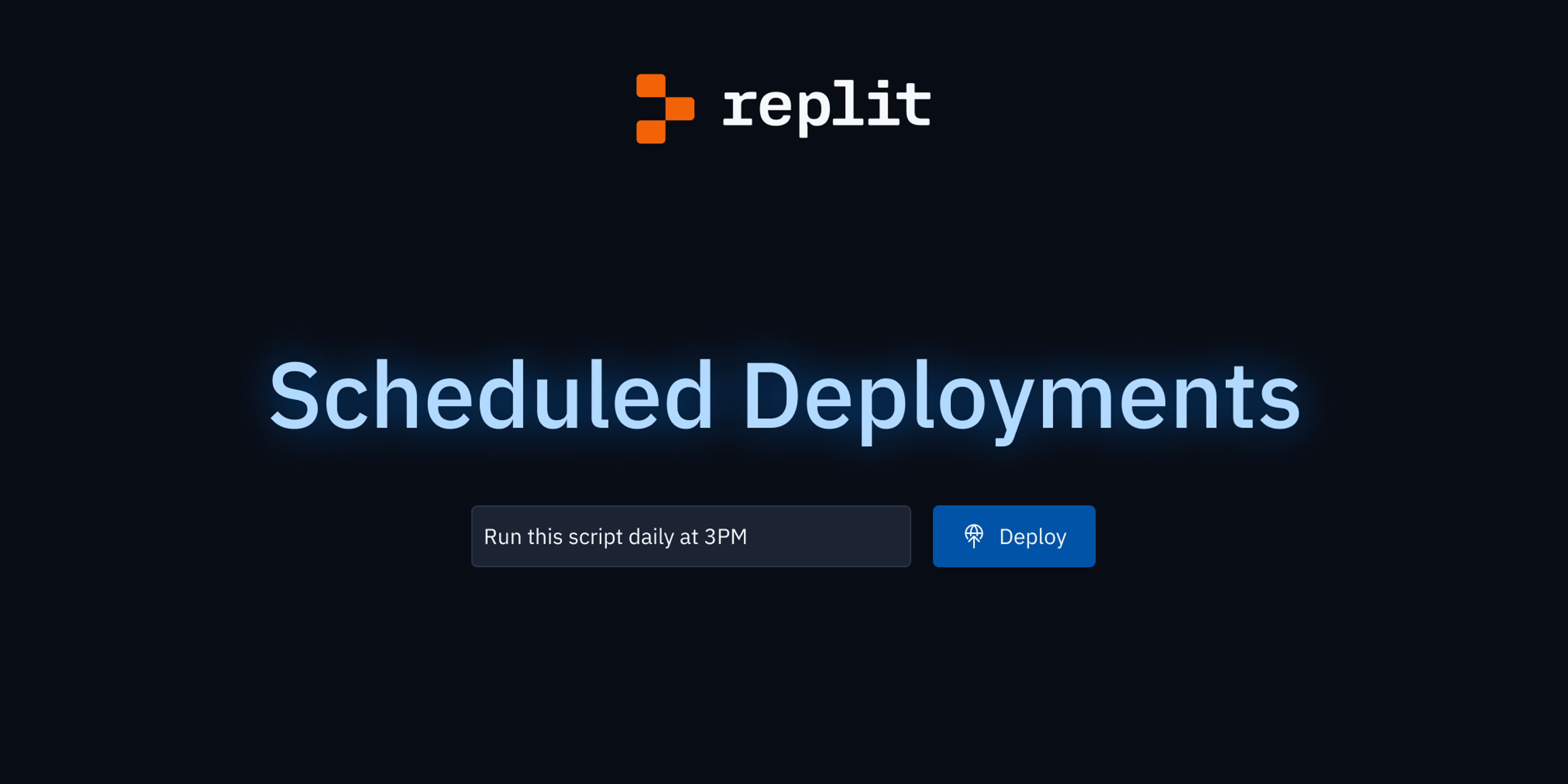
Today, we are launching Scheduled Deployments. This service allows you to schedule your applications to run at predetermined time intervals seamlessly. Specify when the application should run in natural language, and Replit will take care of the rest. Scheduling has always been a popular use case on Replit, but configuring an application like this was difficult. Most developers set up schedulers by deploying an infinite loop that constantly checked the time to a Reserved VM. This process not only had a lot of overhead, but was also inefficient and costly. Now, you can write something like, “Run this script every Tuesday and Thursday at 3:00 PM,” and we’ll generate the cron expression for you so that you can focus on building. What you can build In our closed beta, developers have used Scheduled Deployments to build applications like:
 Wed, Feb 14, 2024
Introducing Multiplayer AI Chat
One of our core beliefs at Replit is that multiplayer collaboration makes building software more creative and efficient. After introducing Replit AI for All last year, we heard from our users how transformative AI has been to their development workflows. Today, we are announcing several updates to our AI Chat product, but most importantly, we are bringing the multiplayer power of Replit to AI. We will continue to offer AI to all users, with advanced models available for Replit Core members, but now with the ability to collaborate with others in multiple, persistent chat sessions. What's new? Multi-session chat with persistence You can now create and manage multiple chat sessions when interacting with Replit AI. Creating multiple threads with our AI products allows you to switch between asking for explanations about files in your codebase, generating code for a new feature, and debugging, all without losing your progress. This was a top feature request, and we’re excited to bring multi-session functionality to the platform so developers can stay organized and engaged, all within the same familiar workspace UI. Collaboration and multiplayer
 Mon, Feb 12, 2024
Flexible Credits and Usage-Based Billing
Replit has evolved from a simple online editor to a comprehensive end-to-end software development platform trusted by developers worldwide. As we’ve grown, we’ve introduced new tools and payment methods for services. We’ve recognized a desire among developers for greater control over their expenses on Replit, and today, we’re introducing usage-based billing. In January 2024, we enabled usage-based billing for any usage that exceeds your plan’s allotment. This change offers a more flexible and transparent view for managing development and deployment costs on Replit. Replit will continue to offer our powerful Starter and Core plans, and any usage beyond plan allotments will be billed via usage-based credit card payments. We’re confident these improvements will make using Replit to scale your projects easier. What's new? Flexible credits Previously, the Replit Core plan included specific allotments for Static and Autoscale Deployments. Feedback from our Replit Core community highlighted a desire for more versatile hosting options, particularly for bots (such as Discord, Telegram, Slack, etc.)
 Thu, Dec 28, 2023
Landscape or Portrait? You Decide
People have expected apps to rotate with their mobile devices since before the introduction of the iPhone in 2007. It’s especially important for productivity apps to adapt and let people choose how they want to utilize their screen space. With the newest version of the Replit Mobile App, you can now code in both landscape and portrait modes. This creates a significantly improved experience on smaller tablets like the iPad mini or larger phones like the Pixel Fold. Want to code on the go with your iPad mini? Simply rotate it to portrait, then later, when you’re home, connect it to your wireless mouse & keyboard and rotate it to landscape for maximal screen space. This is the first of many more improvements to the Replit Mobile App, unlocking your ability to build and launch your next startup from your phone. Updating the Replit Mobile App to respond to orientation changes required navigating a few key areas: Accounting for screen edge insets Creating a friendly API for reacting to and inspecting orientation information Sizing screen content correctly based on orientation The Replit app is built using Expo for React Native, and we use the react-native-safe-area-context library to ensure we display UI in the safe areas of the screen. The addition of camera cut-outs and gesture-based navigation to most smartphones in recent years has made it even more important to account for screen-safe areas when building for a wide range of mobile devices. Properly accounting for screen-safe areas means that the app’s interface isn’t shown under the camera cut-out or behind the system navigation UI. Here’s an example with an iPhone 15 Pro: the non-safe areas where the camera cut-out and system navigation UI live are highlighted in red.