 Fri, Feb 13, 2026
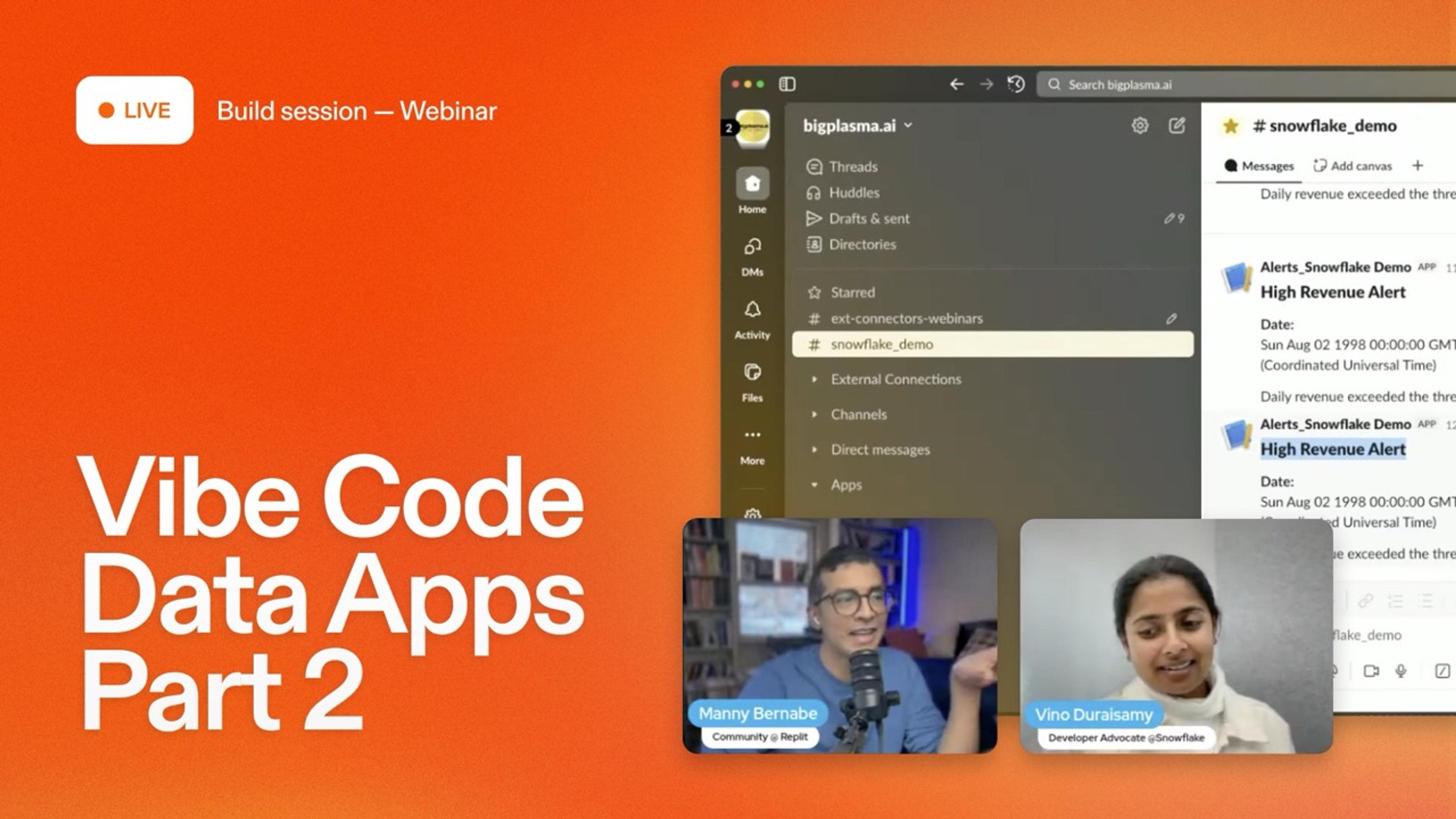
Vibe Coding Data Apps with Replit + Snowflake - Part 2 [webinar]
Summary Snowflake’s Vino Duraisamy and Replit’s Manny Bernabe return to turn simple dashboards into working data tools. Live forecasting and drilldowns explain why metrics move, not just what changed on your Snowflake dashboard. Custom Slack alerts fire when revenue crosses key thresholds so teams catch spikes, drops, and odd days quickly. An embedded AI data assistant answers plain-English questions and shows the exact SQL it ran for every query. Replit handles security scanning, auth, and hosting so you can ship Snowflake-powered data apps in minutes.
 Fri, Jan 30, 2026
Vibe Coding Data Apps with Replit + Snowflake [webinar]
Summary Snowflake developer advocate Vino Duraisamy joins Replit Community Manager Manny Bernabe for another informative live webinar. Replit's Snowflake connector enables builders to vibe code custom data applications without writing code manually. The connector provides secure, read-only access to Snowflake databases, eliminating complex authentication and setup processes. Builders can iterate on dashboards and reports using natural language prompts in plan and build modes. Publishing production-ready apps takes minutes with built-in security scanning, authentication, and deployment features all included.
 Fri, Jan 23, 2026
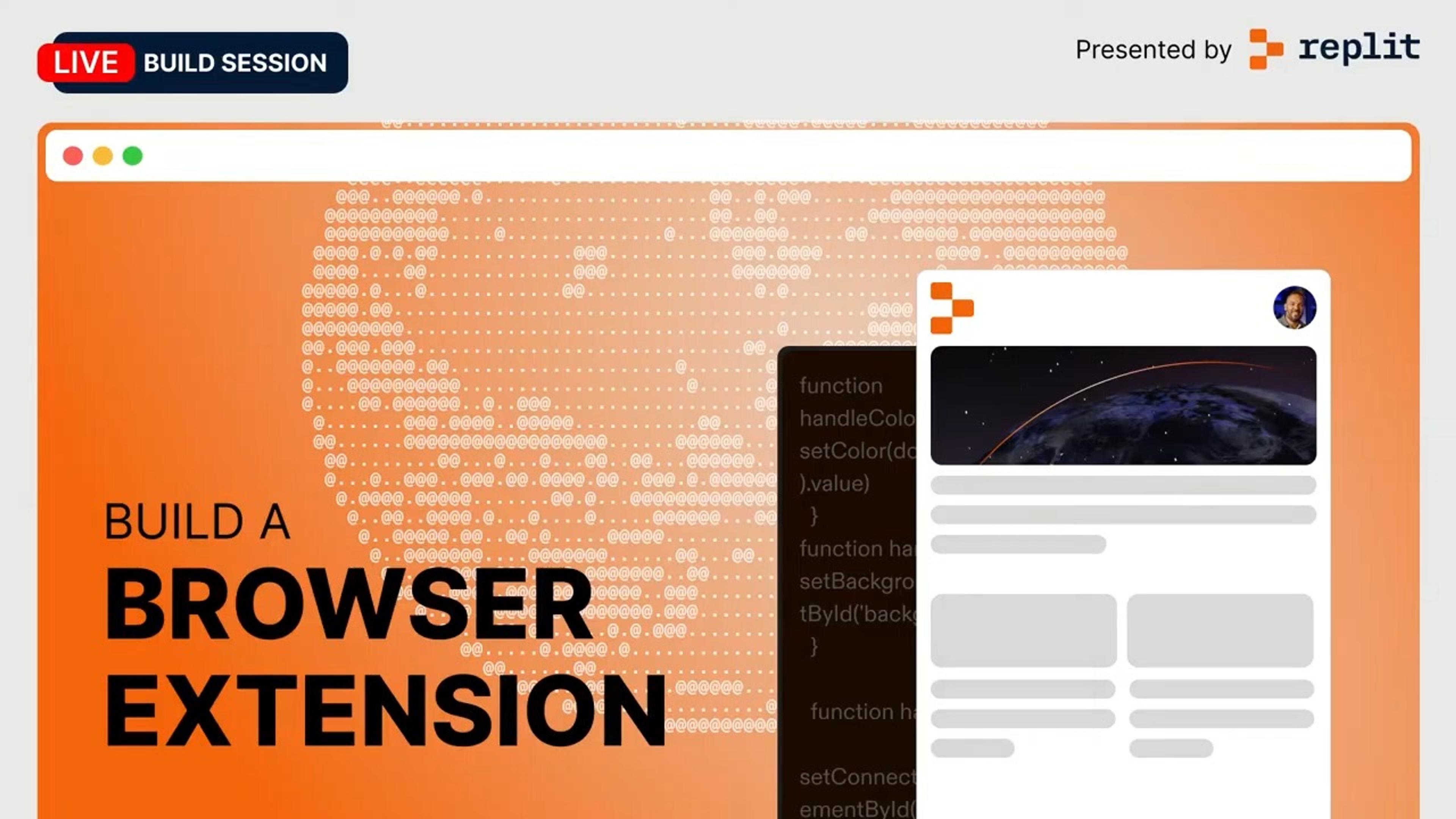
Building a Private Bookmark Manager and Browser Extension in Replit [webinar]
Summary Replit hosted a livestream build session showing how to create a private bookmark manager with a Chrome extension from scratch using Replit Agent in under two hours. The team demonstrated how to write effective prompts, troubleshoot issues, and add AI-powered features like content summarization using OpenAI integration with minimal manual coding. Building the initial functional app and extension cost around five dollars using Replit Agent, with additional costs for feature iterations and enhancements throughout the session. The livestream showcased real-world debugging and problem-solving, including handling database migrations, security vulnerabilities, and browser extension authentication flows as they occurred. The start of 2026 is proving to be an exciting time for builders on Replit. In a recent livestream, community managers Manny Bernable and Raymmnar walked over 1,000 viewers through building a complete bookmark management application with a Chrome extension—live and unscripted—using Replit Agent.
 Wed, Jan 14, 2026
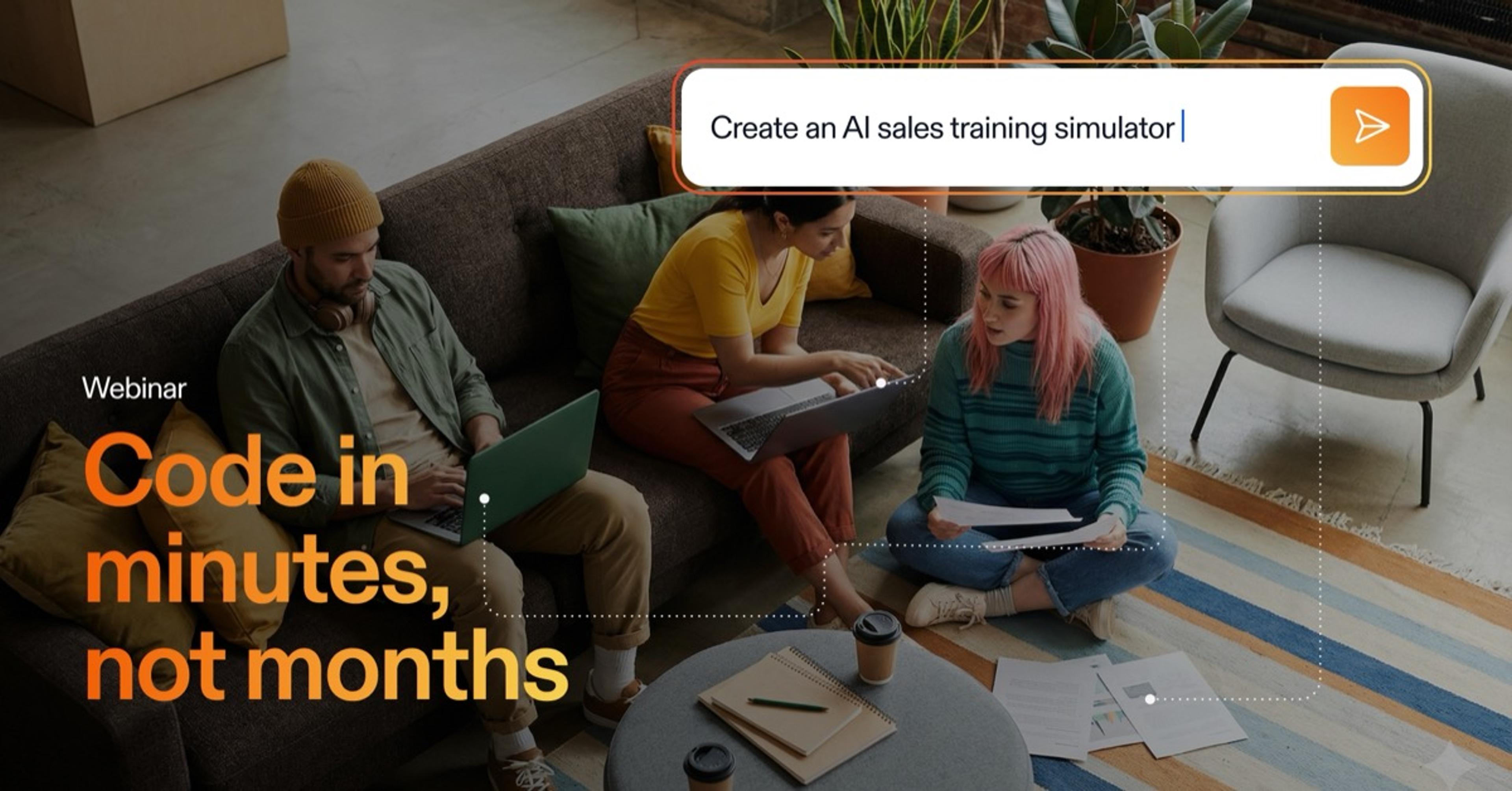
How RevOps Teams Are Building Their Own Tools with Vibe Coding
Summary RevOps professionals are using Replit to build custom micro tools that solve niche workflow problems without technical backgrounds. Teams save 90% of their time by automating tedious processes like mock data generation, CSV enrichment, and HubSpot syncing. Sales teams use AI-powered training simulators to practice cold calls and discovery calls, reducing ramp time from months to weeks. Vibe coding eliminates dependency on engineering resources, allowing go-to-market teams to iterate on solutions in hours instead of months. Building custom tools is becoming a core competency across sales, marketing, and operations—not just for developers anymore.
 Wed, Sep 3, 2025
Introducing Plan Mode: A safer way to vibe code
We are excited to announce Plan Mode, a new way to collaborate with Replit Agent. This mode provides a dedicated space for ideation, task outlining, and strategic discussions—all without initiating any changes to your codebase. The default mode is now referred to as Build mode. Key benefits Plan Mode allows you to: Brainstorm ideas and explore different approaches to your project
 Tue, Apr 22, 2025
Secure Vibe Coding: The Tools and Fundamentals to Vibe Code Securely
Nothing is more exciting than realizing your vision. Nothing is worse than realizing you had a major security flaw. The good news? While security is crucial, it doesn't have to be an obstacle, especially when you're building on Replit. We integrate many security features directly into the platform, and our AI tools can handle much of the heavy lifting, letting you focus on building. This post is your practical guide to navigating security essentials. We'll walk through the key fundamentals to secure vibe coding, provide a security checklis, and give 16 practical tips for how you can vibe code more secure apps (and how to do so simply). Replit's five fundamentals for secure vibe coding Up to 40% of AI suggestions may contain vulnerabilities. At Replit, we've taken a unique approach: making security automatic and integrated for the most secure vibe coding possible.
 Wed, Mar 26, 2025
Secure Vibe Coding Made Simple
As vibe coding revolutionizes app development, security can't be an afterthought—it needs to be a core part of the creation process. Recent Stanford research shows that developers using AI assistants wrote less secure code in 80% of tasks compared to those coding manually, while being 3.5 times more likely to overestimate their code's security. And that's professional developers, we've seen an even more concerning trend among vibe coded apps. At Replit, we don't just take this seriously, we build security into every app you create with Agent, by default—something Replit CEO Amjad Masad has called "the Pit of Success". That's why our apps are secure, by default. We bake security in to the process of building with Agent—so you can focus on creating.
 Wed, Mar 26, 2025
What is Vibe Coding?
From idea to app, fast—that's always been our mission at Replit. But what if you could turn your ideas into working apps without knowing how to code at all? Enter vibe coding: a term that's democratizing app creation for everyone, regardless of technical background. What is vibe coding? Vibe coding refers to the practice of instructing AI agents to write code based on natural language prompts. It's not about being lazy—it's about focusing your time and energy on the creative aspects of app development rather than getting stuck in technical details.
 Thu, Mar 13, 2025
Agent Just Got Eyes — Click. Describe. Done.
Making changes to your app should be as fast as possible. Instead of manually describing what to edit, what if you could just click? Now you can. Meet Element Selector, a simple yet powerful way to select any UI element in your app and modify it instantly with Agent or Assistant. No need to type out descriptions or search through files — just Click. Describe. Done. How It Works Toggle the Element Selector — You can find it alongside the chat input tools in Agent and Assistant. Click to select — Want to edit a button? Change a heading? Just click it. Describe changes — Assistant updates text, colors, or styles in seconds. Use Agent to add features like turning a static list into a searchable one.
 Sat, Mar 8, 2025
Everything you need to know about MCP
You can find the 3-min quickstart from the video here What is MCP? MCP (Model Context Protocol) is a standard way to connect AI models to data sources and tools. It allows AI to access information and capabilities beyond what they were originally trained on. MCP works like a universal connector for AI systems. Just as standard ports let different devices work together, MCP lets different AI models connect to the same tools and data sources. This means developers can build a tool once and have it work with any AI model that supports MCP. It's like the USB-C port of AI applications.
 Tue, Feb 25, 2025
Introducing Replit Agent v2 in Early Access
Smarter with realtime app design preview In partnership with Anthropic’s Claude 3.7 Sonnet launch, we're excited to announce the release of Replit Agent v2 in our early access program. The early access program is available exclusively to users on Replit paid plans who have opted in to Explorer Mode (for instructions on opting in to Explorer Mode, see below). While we're encouraged by initial results, you may encounter speed bumps and areas needing improvement as we continue development. What's new: A more autonomous Agent
 Tue, Feb 4, 2025
Replit launches the first software creation Agent on iOS and Android
You've always wondered why that app didn't exist. Now you can — Make an App for That. We’re thrilled to announce that everyone can now try Replit Agent for free! Check out what we’re launching: Replit launches the first software creation agent on iOS and Android — use our AI app builder to build and deploy apps from your iPhone or Android. Chat with Agent as if texting a friend, and watch as it writes, deploys, and hosts your app in real time — no laptop required. Free Tier for Everyone: Replit Agent is now accessible to everyone with a free tier that includes trying Agent, making it easier than ever to start building apps!
 Thu, Jan 16, 2025
AI Coding is Better with Python
"Can everyone really code with AI?" I hear this question all the time. Usually after someone sees a viral post about an AI-built app and thinks "I could do that too!" But here's what those posts don't tell you: most AI-generated apps are just pretty shells—nice looking websites that lack functionality. Why? Most AI coding assistants build with JavaScript and are optimized for presenting information to the user (frontend development). These apps lack the backends and services that power functional applications. JavaScript is great. It creates beautiful frontends—Replit’s AI tools use it well. But Replit is unique: we don’t only use JavaScript. In fact, there are many times it’s not the right tool for the job. Perhaps you’re:
 Tue, Dec 10, 2024
Announcing the New Replit Assistant
Today on Replit, anyone can take their ideas and turn them into software — no coding required. For nearly a decade, Replit’s mission has been to bring coding to the next billion people. We’ve helped millions of people learn to code and made programming less intimidating. But now, thanks to our Agent and Assistant, our AI coding products, we’re taking a giant leap forward. You don’t need to learn coding to be a creator — you just need an idea. From local realtors in Cleveland to Japanese influencers to product managers at some of the world’s largest enterprises, people are building incredible things on Replit. We no longer need to limit ourselves to being users of software, we can all be creators. Today, we’re taking Replit Agent out of early access and officially launching it with groundbreaking updates that will radically expand who can create software. Let us show you what’s possible.
 Tue, Oct 8, 2024
From localhost to live
If you have a body, you are an athlete. Bill Bowerman, Co-founder, Nike The title "programmer" was always reserved for those who code. So it make sense that shipping software is synonymous with, well... writing code. But is the hardest part about shipping really learning to code? I wish. The hardest part(s) are everything that lives between localhost and live. Today, we're seeing a new class of builders—the AI native developer. These users have some technical prowess and build through clever use of the latest tools. But the problem was never just writing code. Despite lower friction to code, roadblocks still exist. Where, you ask?