
Summary
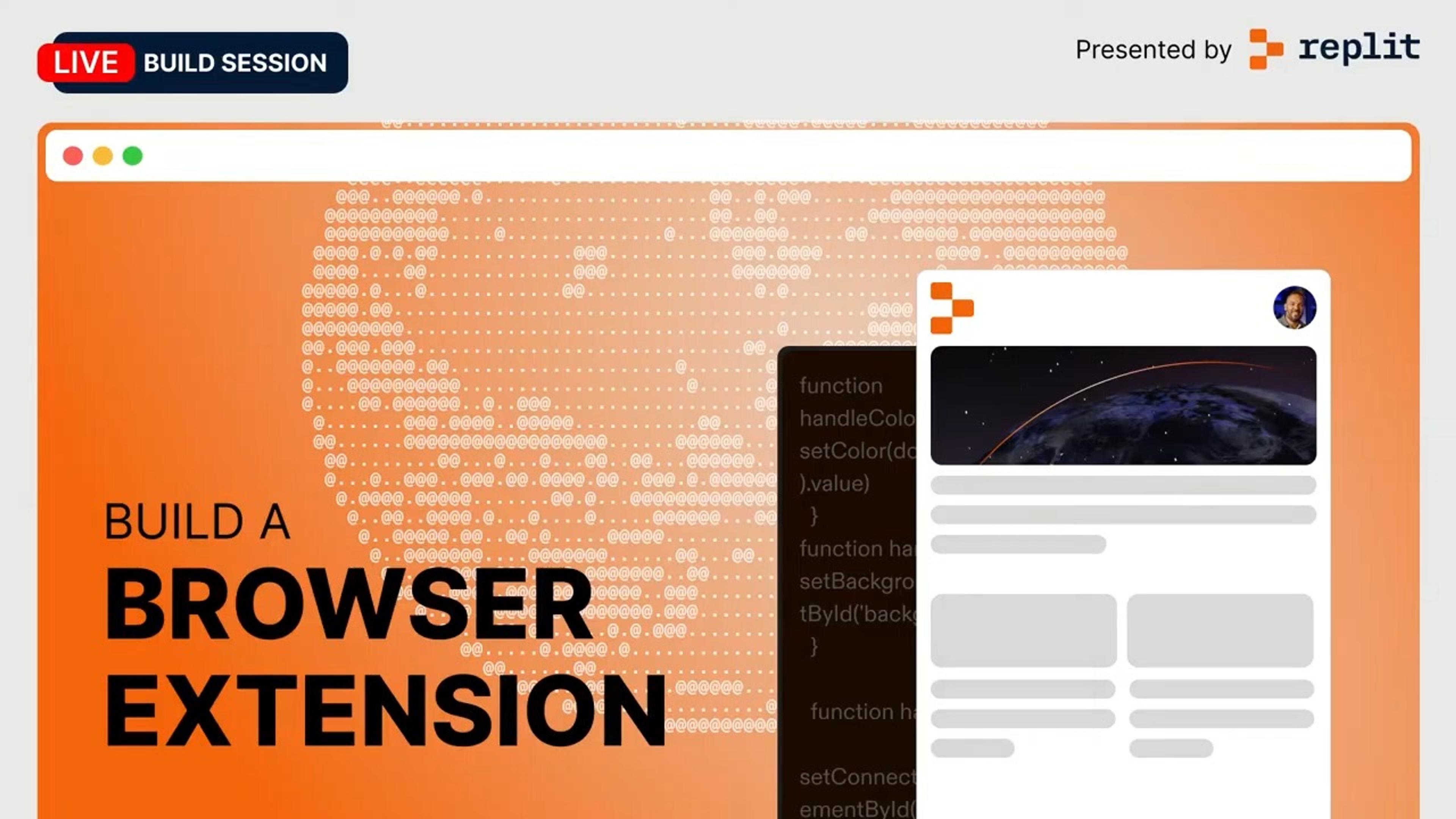
- Replit hosted a livestream build session showing how to create a private bookmark manager with a Chrome extension from scratch using Replit Agent in under two hours.
- The team demonstrated how to write effective prompts, troubleshoot issues, and add AI-powered features like content summarization using OpenAI integration with minimal manual coding.
- Building the initial functional app and extension cost around five dollars using Replit Agent, with additional costs for feature iterations and enhancements throughout the session.
- The livestream showcased real-world debugging and problem-solving, including handling database migrations, security vulnerabilities, and browser extension authentication flows as they occurred.
The start of 2026 is proving to be an exciting time for builders on Replit. In a recent livestream, community managers Manny Bernable and Raymmnar walked over 1,000 viewers through building a complete bookmark management application with a Chrome extension—live and unscripted—using Replit Agent.
(Full webinar video below.)
Setting the stage for 2026
The energy was palpable as hundreds of viewers joined from around the world—from South Africa to Calgary to São Paulo. Manny opened by highlighting what's ahead: the Replit community program is expanding with applications opening in February, and the team is ramping up opportunities for builders to connect both online and locally.
"Vibe coding is going mainstream," Manny noted, referencing a recent post from our CEO, Amjad Masad, featuring Shaquil O'Neil, building apps with Replit. The watershed moment for AI-assisted development has arrived, and more people than ever are eager to understand what they can build.

The power of a well-crafted prompt
Rather than diving straight into code, Raymmar emphasized the importance of prompt engineering. He had prepared his prompts ahead of time by talking through his ideas with ChatGPT, refining requirements, and structuring them in a way that would give Replit Agent the context it needed to succeed.
The initial prompt included core instructions about building a modern web application and browser extension called "MMMarket" (a bookmark manager), specific requirements for Manifest v3 Chrome extensions, color schemes, provided icon files, and detailed user stories describing exactly how someone would interact with the application. Raymmar also included information architecture—the structure of the database, including users, bookmarks, and tags.
"The prompt and the context is everything," Raymmar explained. "If you're not getting what you want from AI, it's likely because you're not giving it what it needs."
Watching Agent work
Once the prompt was submitted, Replit Agent immediately got to work. It created a four-step plan: build website features and design, create backend features and data storage, build browser extension and data sync, and connect features and test everything. Within minutes, Agent had scaffolded the entire application structure, set up Replit Auth and PostgreSQL database, and begun implementing the frontend.
The livestream included several live demos, showing the application taking shape in real-time. The total cost for the initial build? Five dollars and fifty-eight cents for about twenty-two minutes of autonomous work—a fraction of what traditional development would cost.
Real-world troubleshooting
The stream wasn't just about successful builds. Raymmar and Manny encountered several real challenges that showcased the authentic development experience:
Extension authentication issues: Initially, the browser extension wasn't connecting properly to the authentication system. Through systematic troubleshooting and prompting Agent to investigate, they discovered the extension needed proper URL configuration.
Database migrations: When adding AI summarization features, the system detected structural changes to the database and prompted Raymmar to approve migrations—a safety feature that prevents accidentally breaking production data.
Performance problems: After adding content analysis features, the application experienced slow load times. Agent had to optimize how it handled large payloads and adjust server limits.
Throughout these challenges, Raymmar demonstrated best practices: examining console logs, checking database records directly, using clear language to describe problems to Agent, and knowing when to start fresh conversations versus continuing existing threads.
Adding AI-powered features
One of the most impressive moments came when Raymmar decided to add AI-powered content summarization. With a single prompt requesting OpenAI integration to analyze saved bookmarks and automatically generate tags, Agent integrated Mozilla's Readability library to extract clean page content and connected to OpenAI's API through Replit's one-click integration.
"This is what I've been dreaming about for years," Raymmar reflected. "Having a developer that I can sit over their shoulder and just say—try this, move it over here, do that. Almost no developer is ever going to let you do that. But Replit will, for dollars on an hour."
The AI summarization feature worked on the first try after some troubleshooting, automatically generating relevant tags and summaries for bookmarked pages.
The cost conversation
A significant portion of the Q&A addressed concerns about development costs. Both Raymmar and Manny emphasized perspective: "Go call a development shop and ask them how much it will cost to build what we just built," Raymmar challenged. "Most credible shops won't talk to you for less than ten, twenty, fifty thousand dollars."
They also shared practical cost management strategies:
- Use the free plan for experimentation and learning
- Leverage Fast Mode for quick UI changes that cost pennies
- Adjust autonomy settings to control how much Agent does independently
- Start in Plan Mode to align on requirements before building
- Make focused, specific changes rather than vague requests
One viewer shared they'd spent $2,400 building an application but had already generated $20,000 in revenue—demonstrating that cost becomes irrelevant when building something valuable.
Technical deep dives
The session covered several technical concepts that are crucial for building production-ready applications:
Browser extension architecture: Raymmar explained how extensions differ from websites—they run persistently in the background, have access to browser-level events, and require specific permissions declared in a manifest file. The team showed how to load unpacked extensions for testing and manage version numbers.
Security best practices: They ran Replit's security scanner before deploying, which identified potential vulnerabilities. Raymmar cautioned against automatically fixing everything Agent flags, recommending discussion and investigation first.
Git and version control: Throughout the build, Raymmar demonstrated creating manual checkpoints, understanding when files have unsaved changes, and how Replit's immutable git remote provides backup even if the main repository becomes corrupted.
Production databases: The livestream showed Replit's separate development and production database environments, how to approve migrations safely, and why this separation is critical when giving Agent access to your application.
Building the future
The conversation kept returning to a central theme: the line between technical and non-technical is disappearing. "If you're a designer that says 'I'm not technical,' I don't know what that means anymore," Raymmar said. "Design is going to start involving everything. Everything is design. Everything is code."
Both hosts encouraged viewers to push past discomfort with technical concepts, using AI as a tutor to learn along the way. "Every six months, I'm using what I was scared of prior," one commenter noted—a sentiment that resonated throughout the chat.
The complete bookmark manager application built during the stream is available for remixing, and you can find resources from all livestream builds at livebuild.replit.app (a project management tool the team also built with Replit Agent.)