 Mon, Oct 25, 2021
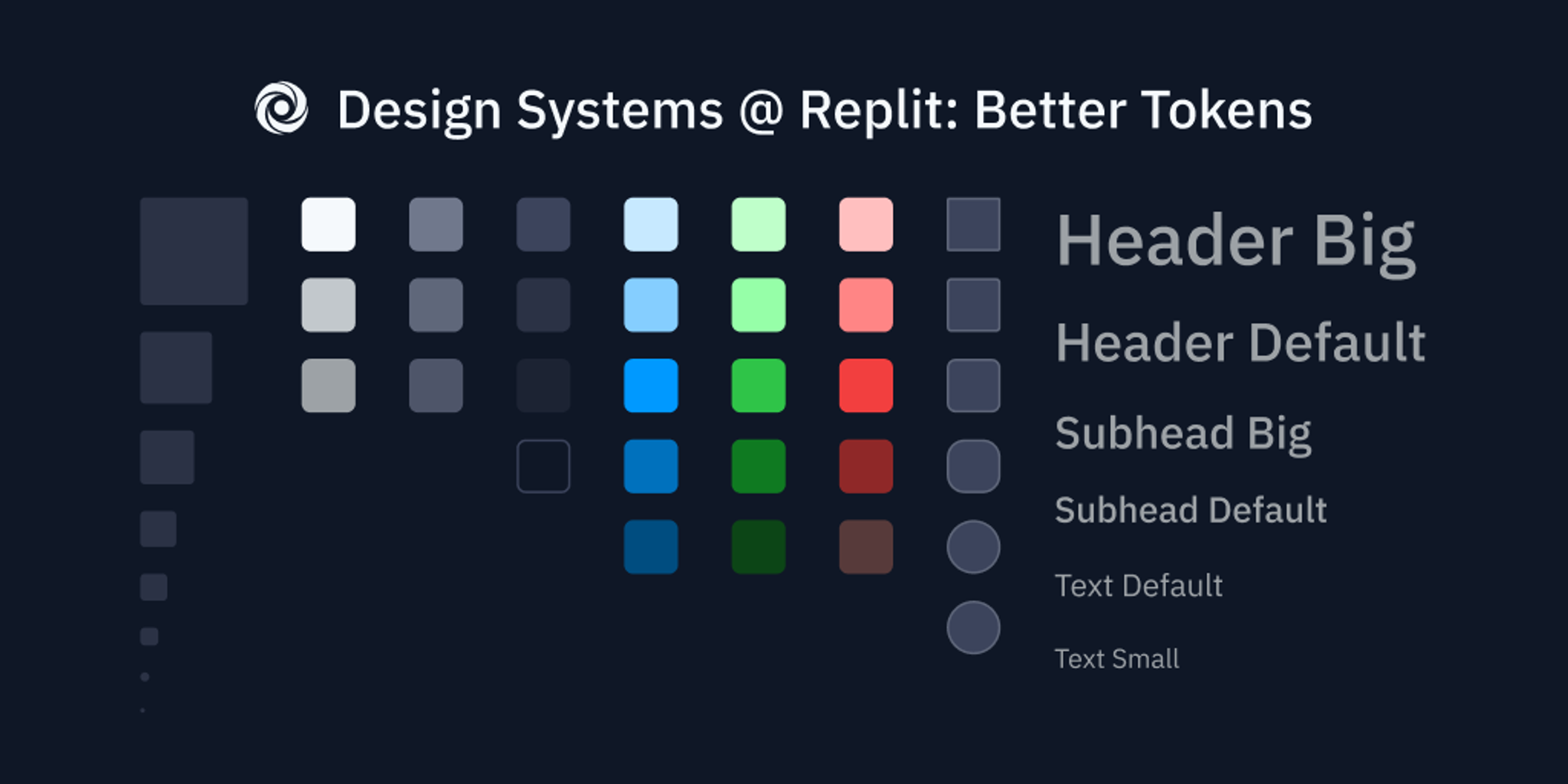
Design Systems @ Replit: Better Tokens
Part 1 of a series about our evolving design system, RUI (Replit User Interface). Replit is growing fast, as an application and a team. New features are being added, new people are joining the platform, and new designers and engineers are building it all. Unfortunately, this means that different parts of the product start to look and behave differently, because no single designer or engineer can keep all the interface states in their head. With dozens of people working on Replit, what happens when you want to update your color or text scheme across the whole site? What if you want users to be familiar with how components work anywhere they see them? It doesn't happen by accident — it requires strong infrastructural basics that you can rely on. So, we spent a few months this year building a stronger foundation for our design system. This is how our system is structured now:
 Sun, Oct 24, 2021
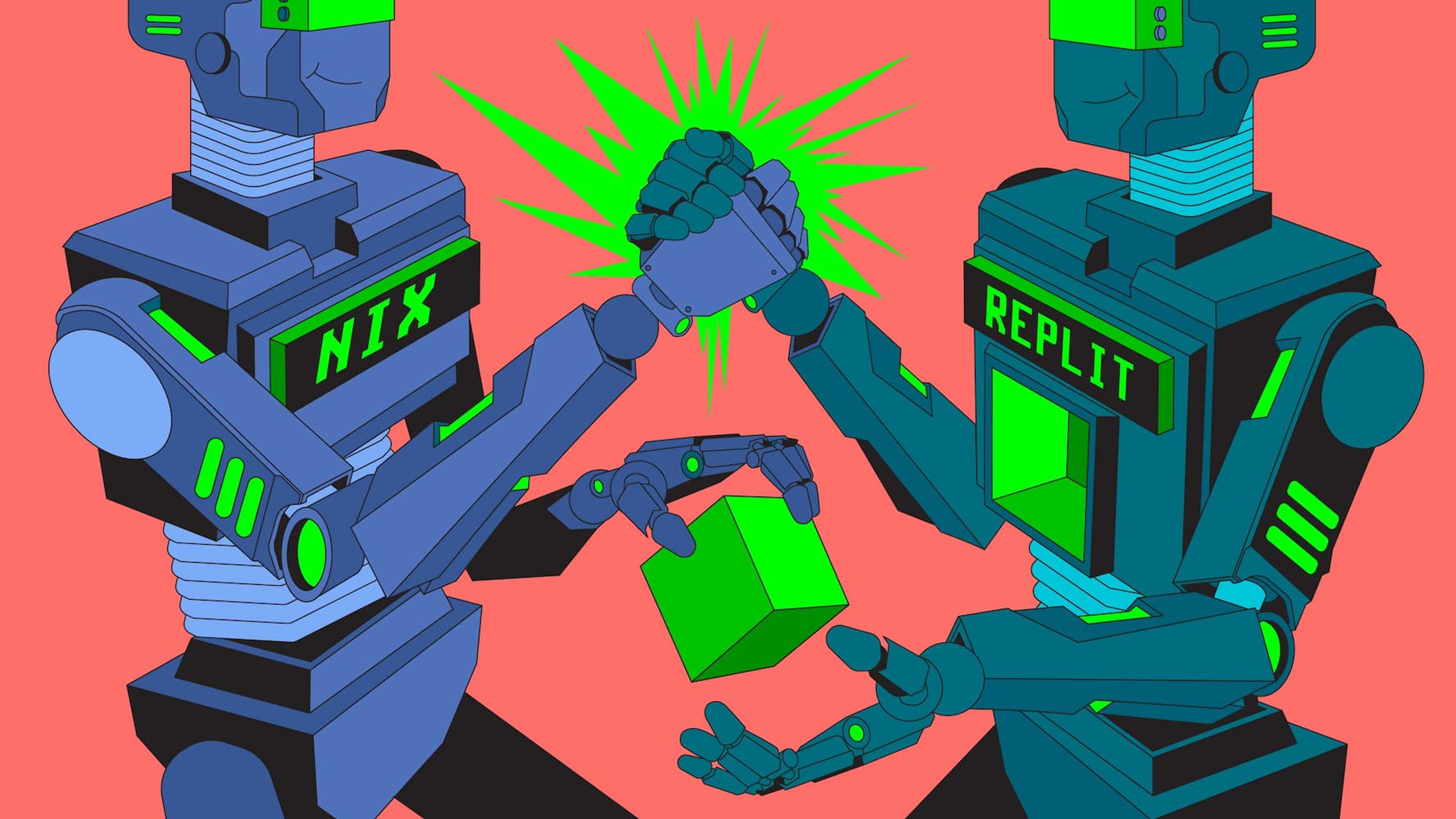
Betting on Nix: donating $25K to the NixOS Foundation
As building software grows more like snapping Legos together, how people find and use those Legos becomes more important. That's why we are donating $25,000 to the NixOS Foundation and betting on Nix as the future of software distribution. In software, the Lego pieces are called packages. A package may be some code your program needs to call (a library) or another program your code needs to run. Historically, people have used package managers to find and install packages into their projects. Each language ecosystem has its own package manager. Replit built and open-sourced the Universal Package Manager to unify this fragmented landscape. Package managers are a holdover from the old model of programming, when development environments lived on personal computers. Now that development environments (ahem, repls) can run entirely in the cloud, fetching packages from a central server, unzipping them, and installing them into a filesystem seems shockingly archaic. The future is instant. When you press the run button in a repl, your code should run immediately, not pause to fetch packages. The Nix project unlocks instant repl runs. Nix uses content-addressable storage for its packages. If you know which package you want to use, you can compute its location on the filesystem without having to search a central repository. Which means we can put every single package on a fast disk in the cloud and skip the fetch-unzip-install cycle. When you press run, your program can instantly access all the packages it needs on a drive already mounted into the repl. The future is reproducible. What does that mean? If your repl works today, it should also work the next time you go to run it.
 Wed, Oct 13, 2021
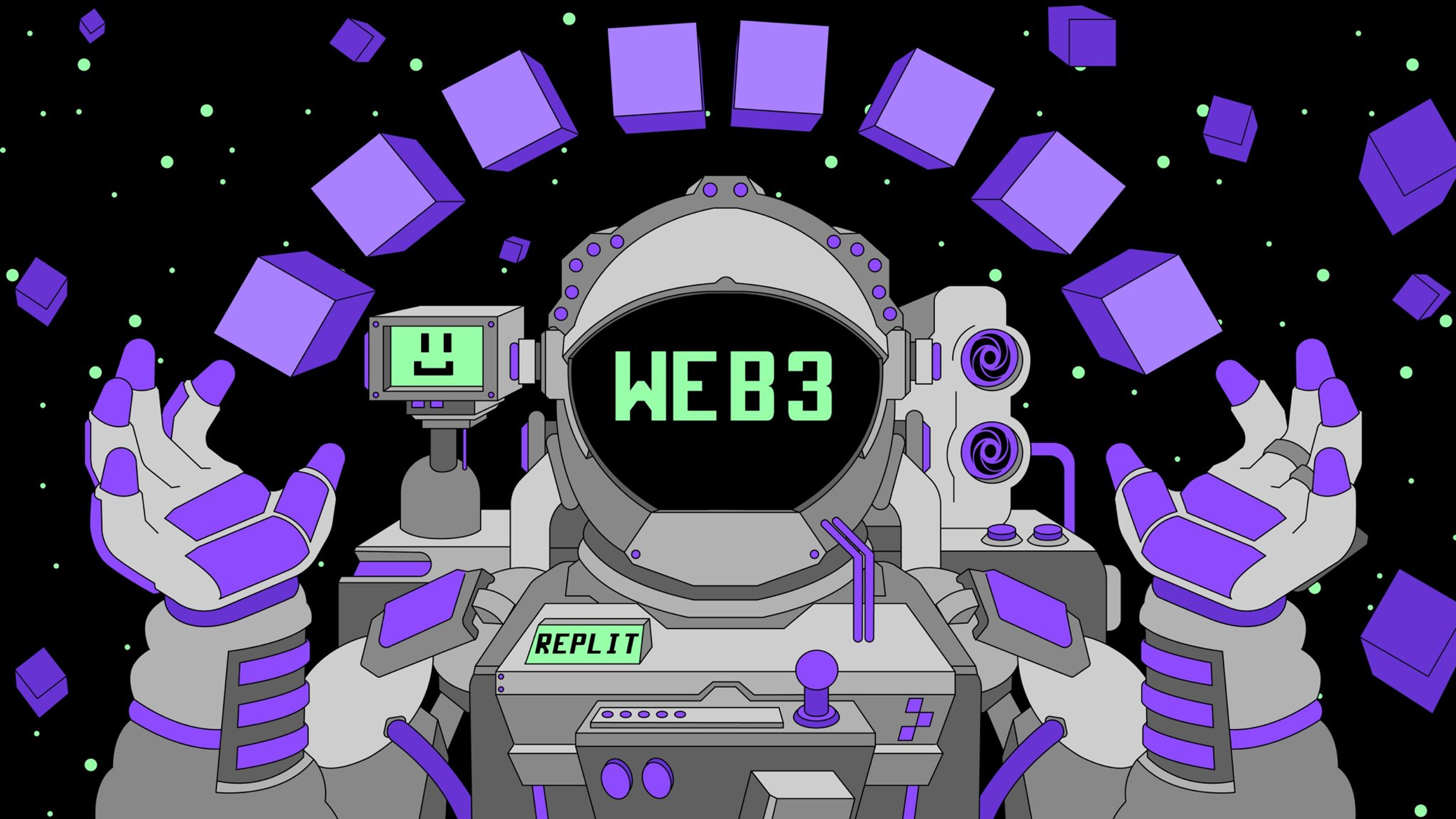
Solidity on Replit: Diving into Web3
Today, we're announcing our official Solidity development template. Solidity is the language used to create smart contracts, which are programs that run on the Ethereum blockchain. This is important for the Web3 commmunity because there's finally an accessible and collaborative way to learn Solidity, which will unlock thousands of new developers in the decentralized web. You can try it out by creating a new Repl and typing solidity in the search bar. Or, go directly to the template page to fork it or leave feedback. :) Why this matters Lowering barriers to entry is core to Replit. Everything we do is intended to make software creation easier, faster, and more fun. So when new infrastructure and communities (like Ethereum) gain momentum, it's our responsibility to help people create for that new technological universe. So, why not try to build the best blockchain development experience in the world? Replit has a unique advantage here. Among other "web-based IDEs", Replit is a true general purpose computing environment. Every Repl you create is actually a Linux container, meaning everything we build sits on top of a fully functioning operating system. This gives us the flexibility to build basically anything we want. Almost any program or environment you can create locally, we can transform into a URL.
 Tue, Oct 12, 2021
Faster Nix Repl Startup
For the past few months we have been working on improving our Nix integration. Nix allows users to easily use over 80,000 Linux packages in a repl. Nix opens the door to many exciting tools and applications on the platform. Our goal is for every repl to be backed by Nix. Before we can do that, we need to ensure that the Nix experience is just as good, if not better, than our existing Polygott solution. If you've used a Nix repl, you may have noticed additional loading time when opening your repl. The console would show "Loading Nix environment..." and you'd have to wait for a few seconds. In some cases, you might have waited for tens of seconds. We care about making repls start up as fast as possible and this additional loading time wasn't acceptable. Through some additional caching, we have entirely removed this loading time on many Nix repls. Now, Nix repls will start up just as fast as Polygott-based repls. See below for a before and after demonstration. Before: After:
 Mon, Oct 4, 2021
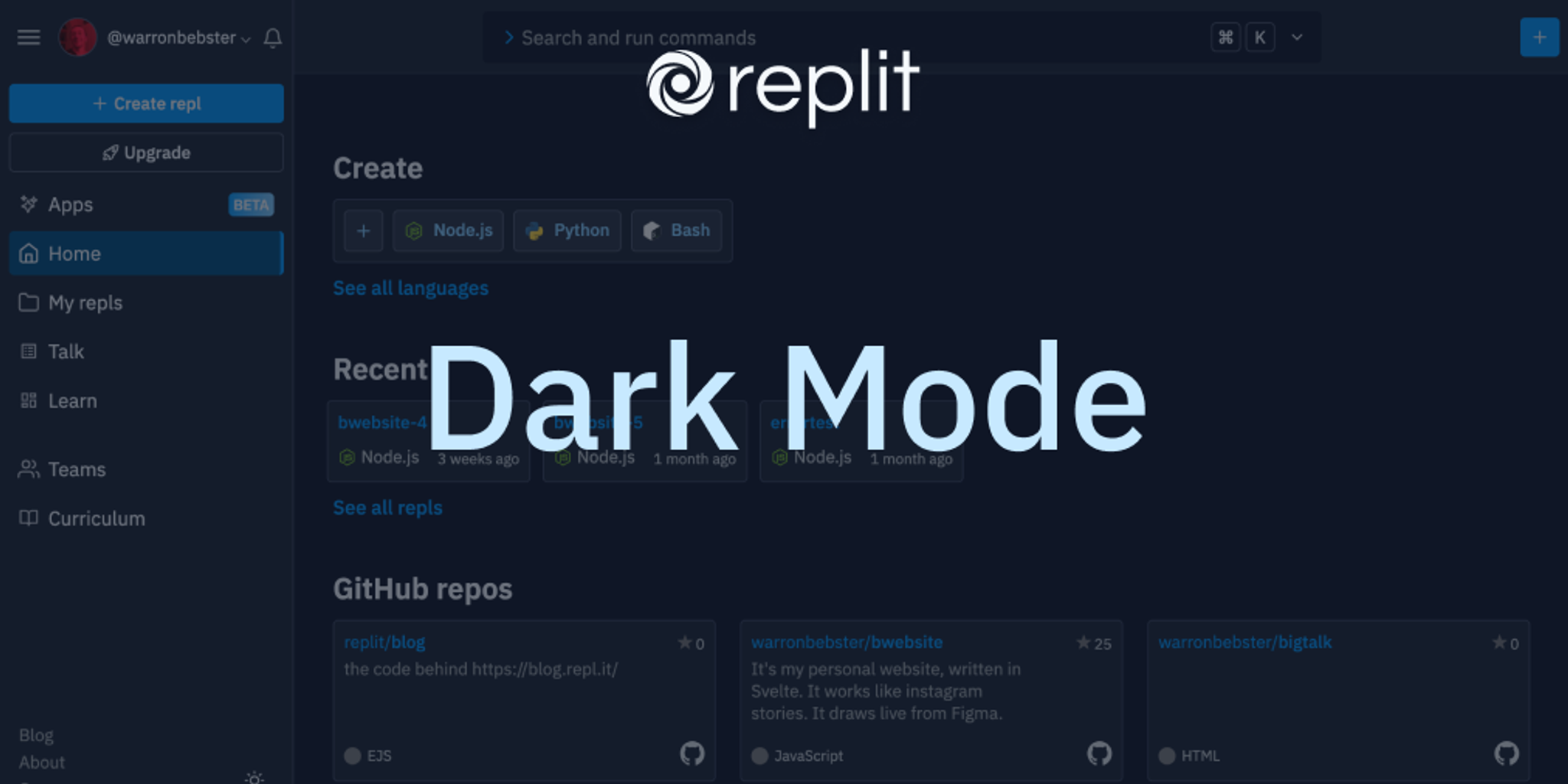
Enter the Shadows with Dark Mode
Looking for how to change your Replit theme? Click here. It's spooky season, so we have a spooky feature for you: Dark Mode™ is now available for everyone on Replit! Just open your sidebar and click the moon to enter the shadow realm. Click the sun to switch back. Dark theme will work across the app — from the homepage,
 Mon, Sep 27, 2021
Replit + Codex - Beta Release
Update: To stay up to date on Replit and AI, check out our Ghostwriter Beta & AI mode announcement. In it we discuss how we infused state-of-the-art intelligence into nearly all IDE features as well as the future of AI on Replit. At Replit, one of our fundamental goals is to make programming easier. When we got a first glimpse at OpenAI's new Codex model, our instinct was to think of how it could help people understand programs better—especially beginners. We've tested ideas before that used OpenAI's more general model, GPT-3, to ask questions about code. Amjad wrote about some of these explorations on our blog last year.
 Mon, Sep 20, 2021
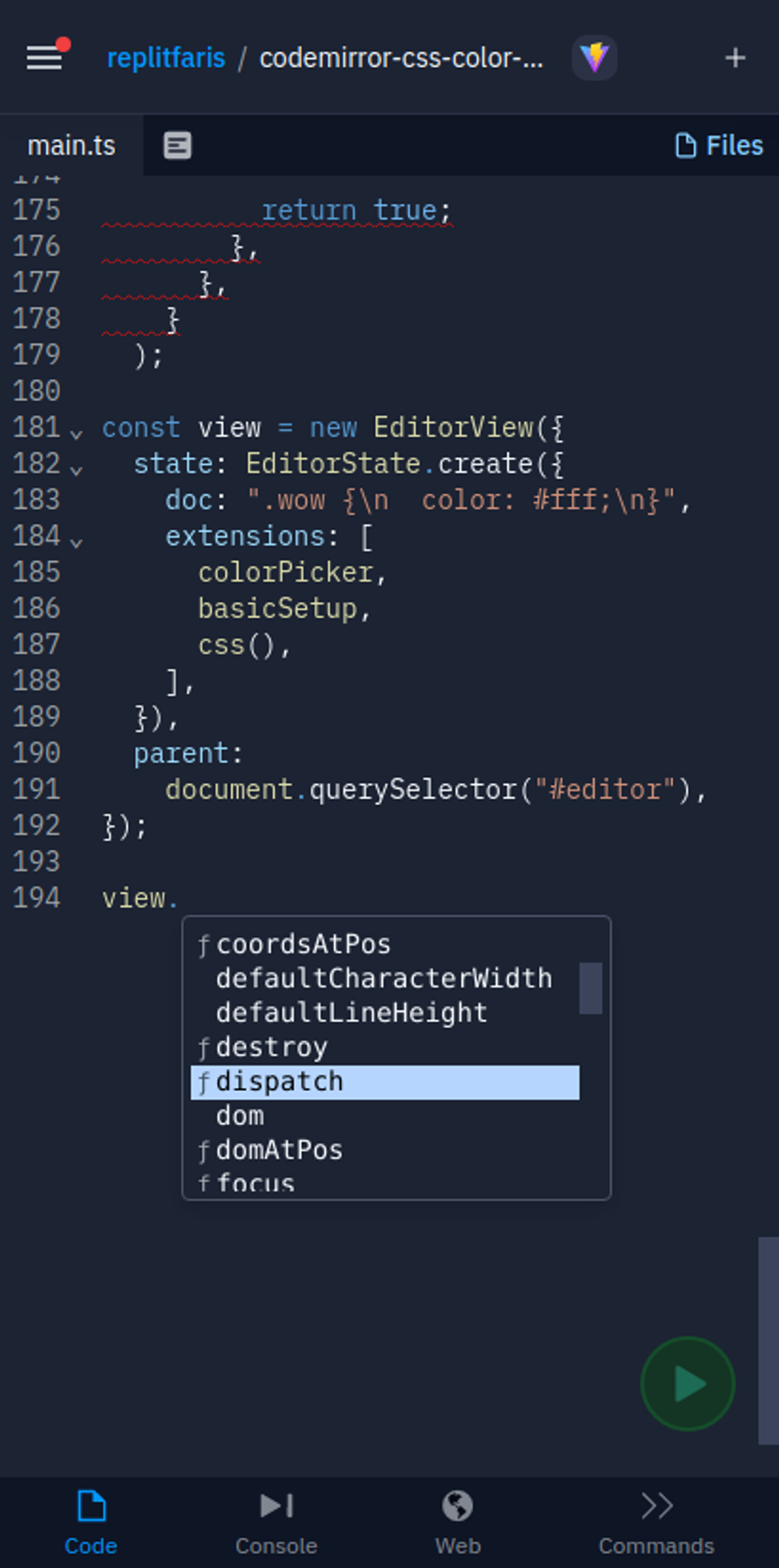
A New Code Editor for Mobile - CodeMirror 6
Today, we are thrilled to announce CodeMirror as the new code editor on Replit for mobile devices. CodeMirror is a versatile code editor that has been specifically designed with mobile in mind, providing an excellent touchscreen experience. This change is the beginning of a focused effort on mobile development here at Replit; the editor is just the first step! The editor supports all the features you expect from a code editor, and we're working on making it even more powerful. We hope this update will be helpful for those of you who do not have access to a computer but still want to learn and create cool things. We are also working on bringing CodeMirror to the desktop to provide a consistent experience no matter what device you or your multiplayer partners are on. We will see many of the features that we currently have only on the desktop ported to mobile in the process. Keep an eye out for threads, debugger, and more on mobile. Watch this blog for a follow-up technical post on our experience with the editors of the web: Monaco, Ace, and CodeMirror. We've got a lot planned for mobile, we are so excited, and we hope you are too!
 Fri, Sep 10, 2021
Data Loss: a sad tale with a happy ending
Earlier this year, we discovered that we were losing data for some of our users. This manifested as either repls being completely empty after reloading, or some of the changes to files not being present after reloading. Obviously losing data is the worst we can do, so we had to fix this immediately. This blog post narrates the adventure of how we discovered this, how we fixed it, and the lessons we learned during the way. The discovery Throughout the year, we had had some worries about some theoretical cases in which users could lose data. We have had a few complaints from people that their code wasn't correctly saved, and since we weren't sure what caused them, we just tried to fix bugs here and there one at a time in an unstructured fashion. Around mid-July, we got an alarmingly large number of reports of people about their code not saving correctly in a short amount of time, ironically just after deploying one such fix. This meant two things: our intuition about folks losing data was correct, but the way we were fixing it was not! This led to the immediate discovery that there were months- or years-old bugs that were silently losing or corrupting data, and some of them turned out to be load-bearing bugs that couldn't be fixed in isolation (since fixing them triggered other kinds of data loss). This made us start a much larger project to have better guarantees and incrementally fix things without regressions. Homer Simpson doing a dramatic impression of this whole situation
 Wed, Sep 8, 2021
New Kaboom Workspace
We made a better kaboom workspace on replit.
- Wed, Sep 1, 2021
Making Replit Faster for Everyone
Replit's mission is to make programming accessible and provide computer superpowers. To achieve that goal, repls need to be fast. To that end we've been working on a number of improvements in our infrastructure and code to unlock faster repls. We constantly analyze the speed of our clusters and identify areas of improvement. Here are a few examples. Editing Code Just Got Faster We split repls woken up by hosting (repl.co, custom domains) to different VMs than repls that you access in the workspace. This makes editing code and interacting with your repl in the workspace faster by ensuring your usage isn't competing with nearly as many other repls. For repls being actively edited in the workspace, we've seen an average 10-20% improvement in speed from this change. This applies across all subscription types including free users. More CPU For Your Repl
 Mon, Aug 23, 2021
Replit Joins Google for Education Integrated Solutions Initiative
New Replit features, powered by Google Cloud, make it easier than ever for students to code. Replit is announcing it has joined the Google Cloud Partner Advantage Program, utilizing Google Cloud as part of its core infrastructure to create accessible coding opportunities for computer science educators and learners around the world. As a participant of the Google for Education Integrated Solutions Initiative, Replit offers customers the ability to collaborate on code from anywhere, on any device. Students and teachers can easily build on Replit from a Chromebook, download it from the Google Play Store to their device, and even integrate Replit Teams for Education into Google Classroom. With the new Google Classroom integration, teachers can bring collaborative coding into their classroom faster than before. They can quickly add every student in their Google Classroom to a Team, easily add Replit projects as Google Classroom assignments, and access time-saving features like autograding tools and an integrated gradebook. As one Replit teacher put it, “I can concentrate on giving more time to working with the children and helping them rather than on housekeeping stuff.” These tools allow educators to focus on the important things, and Replit has those values covered, too. First, Schools and parents can rest assured that their students’ privacy is protected. With the security of Google Cloud infrastructure and FERPA/COPPA compliance built into the product, students can participate freely within a Replit Team for Education. Additionally, Replit has an app in the Google Play Store and will be featured in the Chromebook App Hub, making it easy for students on any device to get started coding. A Replit Teams for Education user, Shane McReavey, shared that “not everyone has the funds to purchase a laptop, so to create that sense of equality, that everyone has an opportunity, that’s where Replit has been really beneficial.” Another member of our teacher community recently shared that “Coding online is the best option for students especially if there is another lockdown. Many of them only have Chromebooks at home.” When so many students are still learning from their computers and tablets at home and numerous schools have opted to distribute Chromebooks to their students, this makes an enormous difference.
- Thu, Aug 5, 2021
Replit²
Replit has many use cases and features, but one that's less talked about is its ability to serve as a secure compute environment for specialized apps. What if you want to build some tool that will generate code, then execute it for your users? Or maybe you are building a specialized online IDE that injects code for users, then executes the bundle? With Replit, you can start building those kinds of applications quickly without having to focus on building a fast and secure backend. Build the frontend, we'll provide the compute power. That's a great promise, but it's not one that is fully documented. Well, now that is a thing of the past! Let's explore how Replit can serve as your compute backend by building a very basic Replit clone. UPDATE 2021-08-16: Please check the section on Security at the end of this post, more details were added and the post was clarified thanks to the help of @AmazingMech2418. Building a compute node A compute node is a single unit (usually a single server, VM, container, or application) of computing power than can execute work. In our case, a compute node will be a single Repl that can execute arbitrary code using an API. We'll be using the Koa.js framework and python in this post. Let's start by creating a new Nix repl. Why Nix in particular? Nix allows us to install any package that can be found on the official Nix package registry. This give us the ability to install any language interpreter or binary we want, provided said language is able to execute arbitrary code. With minimal work, we'll be able to implement multiple languages in our compute backend and execute them through our API.
 Sun, Aug 1, 2021
Building Alexa Skills On Replit
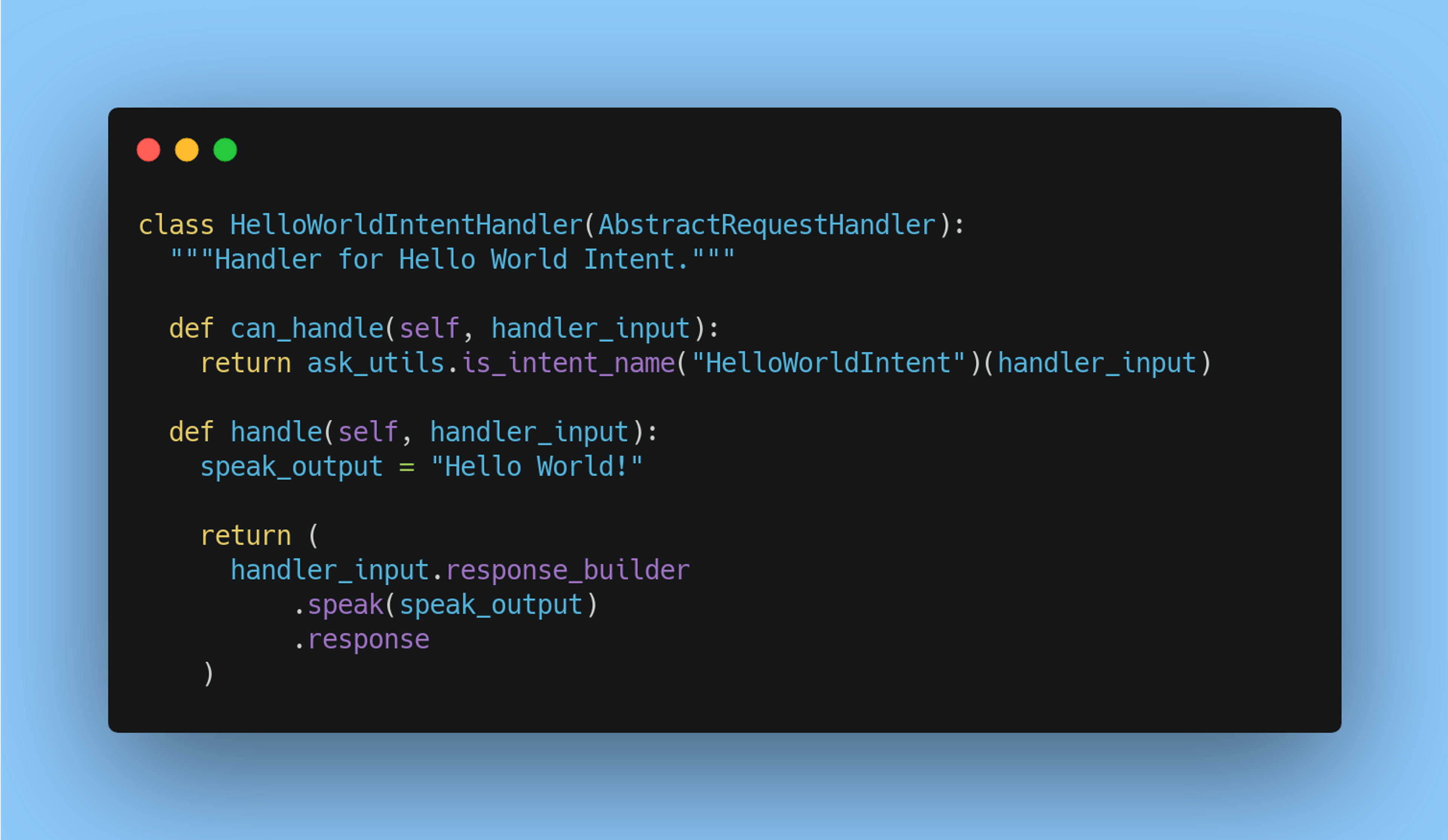
At Replit, we want to give everyone in the world computer superpowers. We’re making it easy for anyone with a Replit account to seamlessly build and host Amazon Alexa Skills on Replit. This blogpost is a start-to-finish tutorial on making Alexa skills on Replit. Something important to note is that you don't need to have a physical Alexa-enabled device to build this. There is a great simulator in the developer console and a downloadable app on your phone. Overview Configure the Alexa skill in the Amazon Developer console Clone the "Replexa" template
- Thu, Jul 15, 2021
Building a web app with Nix (Because why not?)
Learning a new programming language can be a very difficult task. Where should you start? How do I improve my skills from "Hello, World!" to building complete applications? It helps to have a starter project. One of my favourites is building a web app. I have been learning the Nix package manager for a few weeks now - starting with creating a dynamic version system - and I think its the perfect time to write a web application with it (Even though I probably shouldn't). But wait, isn't Nix a package manager and reproducible build system? Am I going to write an entire post on how to package a PHP app with Nix and run it? Well, yes and no. Nix is indeed a build system, but Nix packages are configured using a functional programming language (also named Nix) created specifically for the Nix package manager. Since Nix is a complete programming language, this means we can execute it without building a package thanks to the interpreter built into the Nix package manager itself. Clearly, Nix was not built for web development, but let's see how far we can take it. Hello, World! In the long list of reasons why Nix was not created for building web applications, we have the reality that starting a web server that executes Nix code through Nix itself is not feasible at the moment. Nix is not the type of application that can be configured to wait for calls on some hostname/port and execute arbitrary code when a client connects. It is much easier to use something like nix eval through a more standard web server, so we'll do just that. Let's start by creating a mandatory "Hello, World!" example with Nix. For this post, I have created all the code inside of a Nix repl on replit.com. Feel free to follow along in that repl or to create your own. Create a new repl using the nix (beta) language to get started, click on the three dots icon next to the Files header in the filetree and select "Show config files". Once the config files are visible, open the replit.nix file and replace pkgs.cowsay with pkgs.python3, we will need python later. Now that the repl is configured, create a default.nix file inside of a directory named app and write the following code in it.
 Thu, Jul 8, 2021
Building the future of collaborative coding
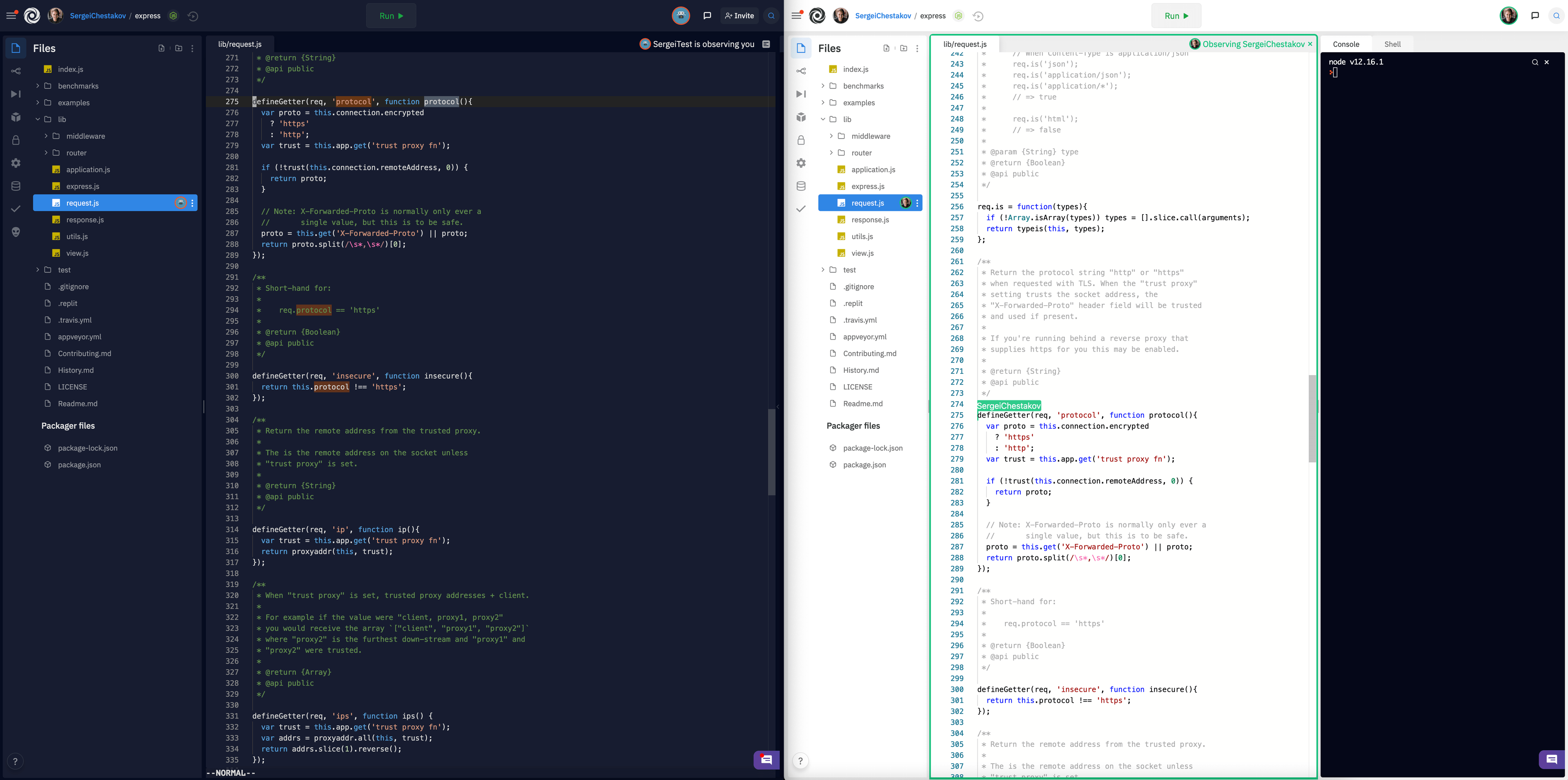
One of the most powerful aspects of Replit is the ability to collaborate with friends and peers in real time. When we first added support for multiplayer, we set out to make it as easy as possible to code with others. Since then, collaboration has become an integral part of our product with the release of features like threads and draw. By continuing to improve the multiplayer experience on Replit, our goal is to dispel the myth that programming is a lonely activity. Instead, we aim to remove the barriers that impede the learning, creativity, and fun that collaboration often fosters. This is why we're excited to announce two new features that make collaborating on Replit even easier: Observation Mode and Filetree Presence! Observation Mode Oftentimes, when you're coding with someone, you might want to follow their progress more closely. Whether you're teaching a class, hacking with friends, or leading an interview, it can be useful to zoom in on a collaborator's activity to see what they're working on. Previously, you might have done this by hopping on a video call and sharing your screen, but that can be overkill in many scenarios. Luckily, there's now an even easier approach built right into Replit called Observation Mode! To start observing someone, simply click on their avatar in the header. If you're in a larger session (4+ people) and you don't see their avatar, you can click on the more users button and find them there like so: