 Thu, Jul 13, 2023
State of AI Development: 34x growth in AI projects, OpenAI's dominance, the rise of open-source, and more
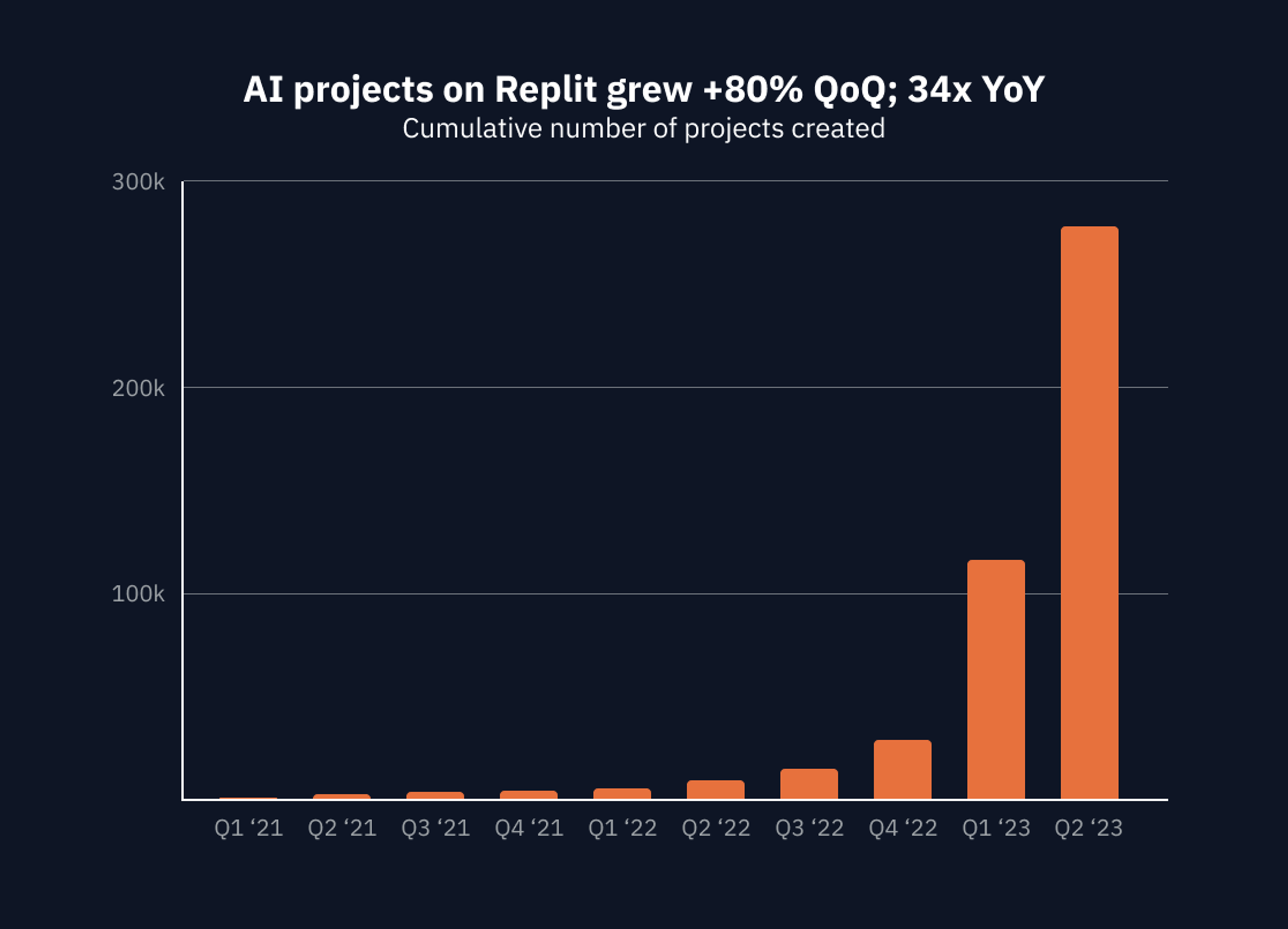
With the introduction of Large Language Models (LLMs), for the first time, Machine Learning (ML) and Artificial Intelligence (AI) became accessible to everyday developers. Apps that feel magical, even software that was practically impossible to build by big technology companies with billions in R&D spend, suddenly became not only possibly, but a joy to build and share. The surge in building with AI started in 2021, grew rapidly in 2022, and exploded in the first half of 2023. The speed of development has increased with more LLM providers (e.g., Google, OpenAI, Cohere, Anthropic) and developer tools (e.g., ChromaDB, LangChain). In parallel, natural language interfaces to generate code have made building accessible to more people than ever. Throughout this boom Replit has grown to become the central platform for AI development. Tools like ChatGPT can generate code, but creators still need infrastructure to run it. On Replit, you can create a development environment (Repl) in seconds in any language or framework which comes with an active Linux container on Google Cloud, an editor complete with the necessary tools to start building, including a customizable Workspace, extensions, and Ghostwriter: an AI pair programmer that has project context and can actively help developers debug. Deployments allowed developers to ship their apps in secure and scalable cloud environments. Given our central role in the AI wave, we wanted to share some stats with the community on the state of AI development. Building with AI Since Q4 of 2022, we have seen an explosion in AI projects. At the end of Q2 ‘23, there were almost 300,000 distinct projects that were AI related. By contrast, a search of GitHub shows only ~33k OpenAI repositories over the same time period.
 Thu, Jun 29, 2023
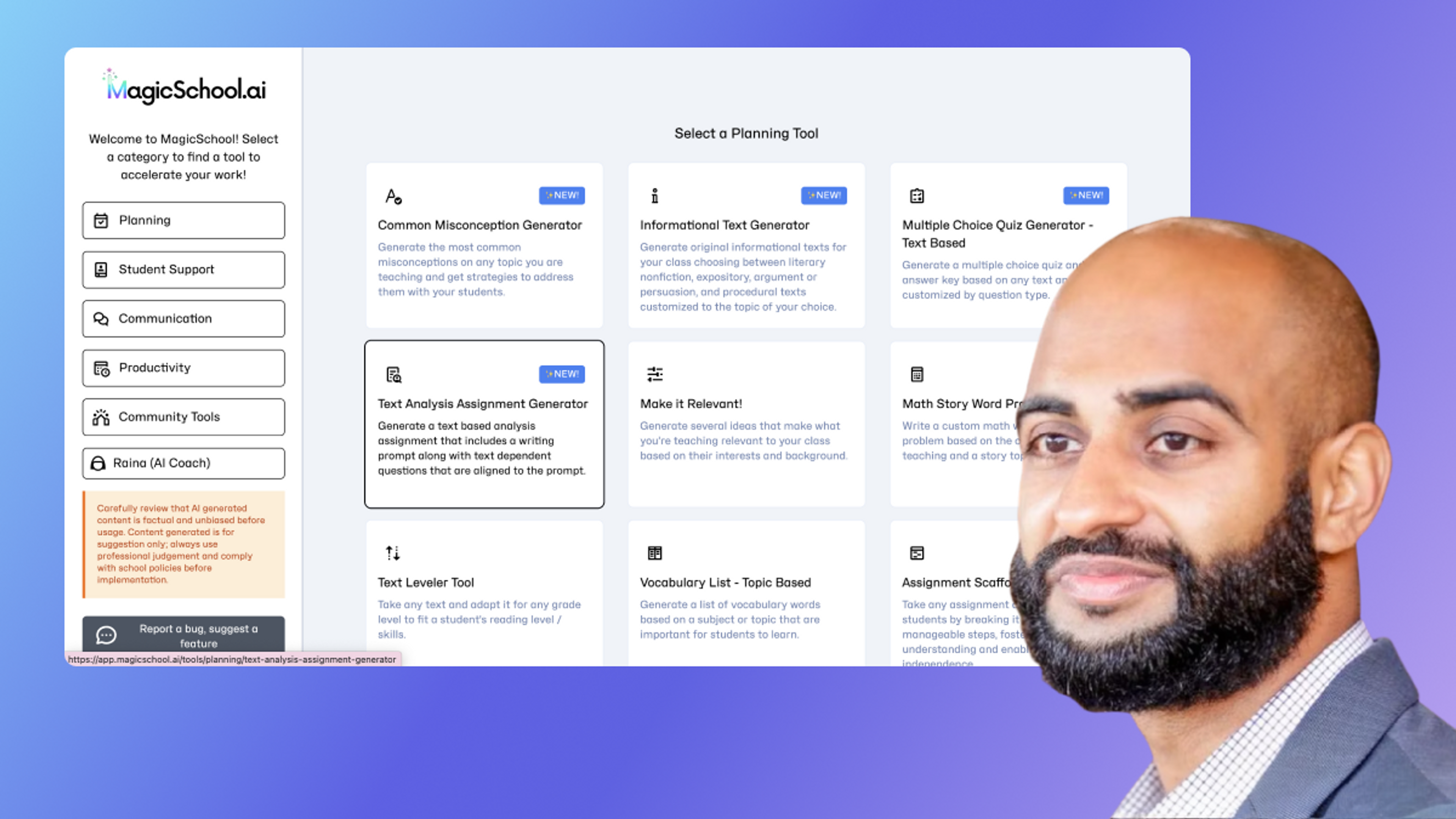
Empowering Educators with MagicSchool and Replit Deployments
Replit is where builders come to bring their software and app ideas to life, fast. We’re showcasing builders and the software they created and deployed on Replit. If you interested in being showcased, click the button below.
 Sat, Jun 24, 2023
The Journey To Code Search
Finding that one comment, class, or function in your codebase is important. You might not always know where to look... which is why we created a brand new Code Search tool! From simple queries to regular expressions it has never been easier to get work done on Replit. The new Code Search tool supports queries with word filters, regular expressions, include patterns, exclude patterns, as well as replacements (with regular expression capture group support) so that you can find what you need and make refactors on larger codebases quickly and efficiently. Try it out now on Replit! But don't forget to come back to this post so we can bring you on our Journey to Code Search. How It All Started
 Sat, Jun 24, 2023
Internship Experience At Replit
Hey! I'm Nathan. It's been a short but exciting few months at Replit, and I wanted to share my experience with you all. The Journey Begins I started programming back in 2018. Since then, I’ve met fantastic people, learned new stuff, and made a lot of wacky projects. What I did not expect was a technical recruiter to reach out to me through Twitter.
- Mon, Jun 12, 2023
June 6, 2023, Single-Sign-On Security Vulnerability
Earlier today, we emailed users about a security vulnerability affecting parts of our single-sign-on functionality. While we’ve fixed the vulnerability and have found no evidence of any exploit, we are publishing this post out of transparency. On Tuesday, June 6, while auditing our authentication systems, we investigated a possible vulnerability related to our single-sign-on functionality. We patched the vulnerability the same day and proceeded to investigate whether any users could’ve been affected by it. On Thursday, June 8, we identified a subset of users who had previously used our single-sign-on functionality and were potentially exposed to this vulnerability. In particular, if the email address on record for a user’s Replit account was not already tied to a GitHub account, an attacker could have created a GitHub account by re-using the email address on record for the user’s Replit account. Under certain conditions, it would have been possible to use that fraudulent GitHub account to impersonate the affected user on Replit. While we have no evidence that a third party logged into any Replit account this way, out of caution, we have logged out of all Replit sessions all users who we could identify as potentially fitting these criteria. Additionally, out of an abundance of caution, we have logged out all users who have ever used our single-sign-on functionality with a GitHub, Facebook, or Apple account. We take the security of our users' accounts seriously. We continuously perform security audits and, when we discover issues, we proactively address them and harden related systems. In the coming months, we will continue to make substantial improvements to our authentication systems to make them more secure and user-friendly. If you are experiencing trouble logging back into your account or have additional questions, please reach out to support.
- Fri, Jun 9, 2023
Keeping Your API Keys Safe
Replit gives you the power to both build your own applications and to leverage powerful third party services through their APIs. By integrating third party services into their Repls, Replit users have unlocked a diverse range of capabilities such as speech to text, video livestreaming, embedding data into AI applications, and even tracking Amtrak trains. Integrating a third-party service into your Repl usually involves acquiring an API key or token from the third party that uniquely identifies you and your app. It’s important to keep this API key secret because if it is leaked and used by someone else, they could misuse it while impersonating you. You could find yourself losing your API access, or even incurring unauthorized charges. We saw this need and developed tooling around it for you. Replit makes it easy for you to protect your API keys, by using Secrets. When you add your API key as a Secret, you make sure that it won’t be visible to others who view your Repl’s code, and won’t be included if anyone else forks your Repl. With the recent explosion of interest in AI, there has been a corresponding rise in the theft of OpenAI API keys in particular. Replit is doing its part to make sure that our users don’t become victims of this crime. We have been a partner of OpenAI’s since 2021 and care deeply about AI development and security.
 Tue, Jun 6, 2023
Revolutionizing Language Learning with Replit Deployments
Replit is where builders come to bring their software and app ideas to life, fast. We’re showcasing builders and the software they created and deployed on Replit.
 Mon, Jun 5, 2023
Replit AI Manifesto
Amjad Masad, CEO: I'm excited to welcome Michele Catasta to the Replit team as our VP of AI. Michele joins us from Google, where he was Head of Applied Research at Google Labs and, before that, Google X, where he researched Large Language Models applied to code. Michele has a Ph.D. in Computer Science and was Research Scientist and Instructor in AI at Stanford University. This manifesto is a culmination of a conversation Michele and I have had for over a year on the future of AI and its impact on the software industry: “People who are really serious about software should make their own hardware.” [1982] More than 40 years later, Alan Kay’s quote still sounds as relevant as it gets – no wonder he is recognized as one of the most influential pioneers of our industry. As a matter of fact, over the past few decades software and hardware worked in conjunction to dramatically augment human intelligence. Steve Jobs celebrated Alan’s quote in his famous 2007 keynote, right after launching the very first iPhone – possibly one of Steve’s mottos, considering how Apple built its reputation and massive success story on unprecedented software/hardware integration. At Replit, our mission is to empower the next billion software creators. Our users build software collaboratively with the power of AI, on any device, without spending a second on setup. We accomplished that by creating from the ground up a delightful developer experience. The Replit development environment allows our users to focus solely on writing software, while most of the hardware (and Cloud computing) complexities are carefully hidden away.
 Wed, May 31, 2023
Replit Builders Series - NodePad: From Idea to MVP with Replit Deployments
Replit is where builders come to bring their software and app ideas to life, fast. We’re showcasing builders and software they created and deployed on Replit. NodePad is a platform for idea exploration driven by AI. NodePad founder Saleh Kayyali went from designer to consumer app founder. The app he built and deployed end to end on Replit has thousands of users and slick UI. It shot to #5 on HackerNews, and yet he’s never been paid to develop software before. How?
 Mon, May 29, 2023
Configurable Keybindings for the Workspace
We recently launched customizable keyboard shortcuts to supercharge the workspace for every Replit user. This makes Replit more powerful for everyone, from beginners to experts, by unlocking the ability to perform more actions in the workspace without leaving your keyboard. Defining all the actions available to a user in a keybindings system also increases the discoverability of lesser-known features. Finally, the increased customization handles the challenge of building for many types of users working in different environments. How keybindings work To see all the keybindings available to you, you can head to the Settings tab in the workspace. Your keybinding settings follow you across Repls, browsers, and devices with no work required. Search for a keybinding by name, description, or simply the keybinding itself by pressing the “Record” button to the right of the search bar. Changes to your shortcuts are saved instantly, and the UI updates accordingly to handle your new keybinding settings.
 Thu, May 25, 2023
Super Colliding Nix Stores: Nix Flakes for Millions of Developers
We’ve teamed up with Obsidian Systems and Tweag to enable Nix to merge multiple (possibly-remote) Nix stores, bringing Nix Flakes and development environment portability to millions of Replit users. Nix is an open-source cross-platform package manager and build tool that lets you access the most up-to-date and complete repository of software packages in the world. Nix’s approach to package building ensures that software and development environments will always work the same way, no matter where it is deployed. Replit has bet big on Nix because we believe in a future where developers are free from the drudgery of setting up their development and production environments. A world where onboarding a co-worker is as simple as forking a Repl. When you use Nix to describe your environment, you don’t have to redo your setup everywhere you want your code to work. As Mitchell Hashimoto, founder of Hashicorp, said: one big benefit is that once you adopt Nix, you can get a consistent environment across development (on both Linux and Mac), CI, and production.
- Fri, May 19, 2023
May 18 Replit downtime
Yesterday, we had a period of about 2h from 11:45 to 13:56 (Pacific Time) in which all users were unable to access their Repls through the site. We have addressed the root cause, and the system is now operating normally. We know a two-hour downtime is not acceptable for you or your users. This post summarizes what happened and what we're doing to improve Replit so that this does not happen again. Technical details Here is the timeline of what happened, all times in Pacific Time: In 2021, we changed the way that configuration is pushed to the VMs that run Repls and streamlined multiple kinds of configurations. During this migration, a latent bug that we had not hit was introduced. When we tried to see if a configuration kind had been updated, we acquired a Golang RwMutex for reading, but if there was not a handler for that configuration kind, the read-lock would not be released. Golang's RwMutex are write-preferring, so acquiring multiple read-locks is allowed as long as there are no goroutines attempting to acquire a write-lock. When that happens, it will cause any future read-locks to block. On May 16, 2023,we introduced a new configuration kind, but we did not add a handler, which means that from this point on we were leaking read-locks, but the system was able to make progress.
 Sun, May 14, 2023
Making Git Good
Improving Git on Replit There has been a new Git pane in Repls for a little while now. This new Git UI you see is a part of a complete rewrite of everything Git-related on Replit: both engineering and design. It is the start of our journey into more deeply integrating Git into Replit, with much more to come. Let's talk about it!
 Mon, May 8, 2023
Recapping the SPC-Replit AI Hackathon
This is a guest post by South Park Commons. SPC is a community of 500+ builders, technologists, and domain experts with locations in San Francisco and New York City. The recent SPC-Replit AI hackathon brought together talented builders from the SPC community and Replit network to show off their technical chops and creativity by building cutting-edge AI applications. Participants had a week to develop a working demo that incorporated AI in some capacity and was built on Replit. From meal planning to baby-AGI's and even a bot that points out logical fallacies, these projects are proof of the limitless potential of AI. Check out the individual project highlights below! Dialectic - Improving Conversational Health - 1st Place 🥇 Team: Somudro Gupta & Casey Caruso
 Fri, May 5, 2023
Replit Bounties: AI-Powered Real Estate Recommendation Webapp
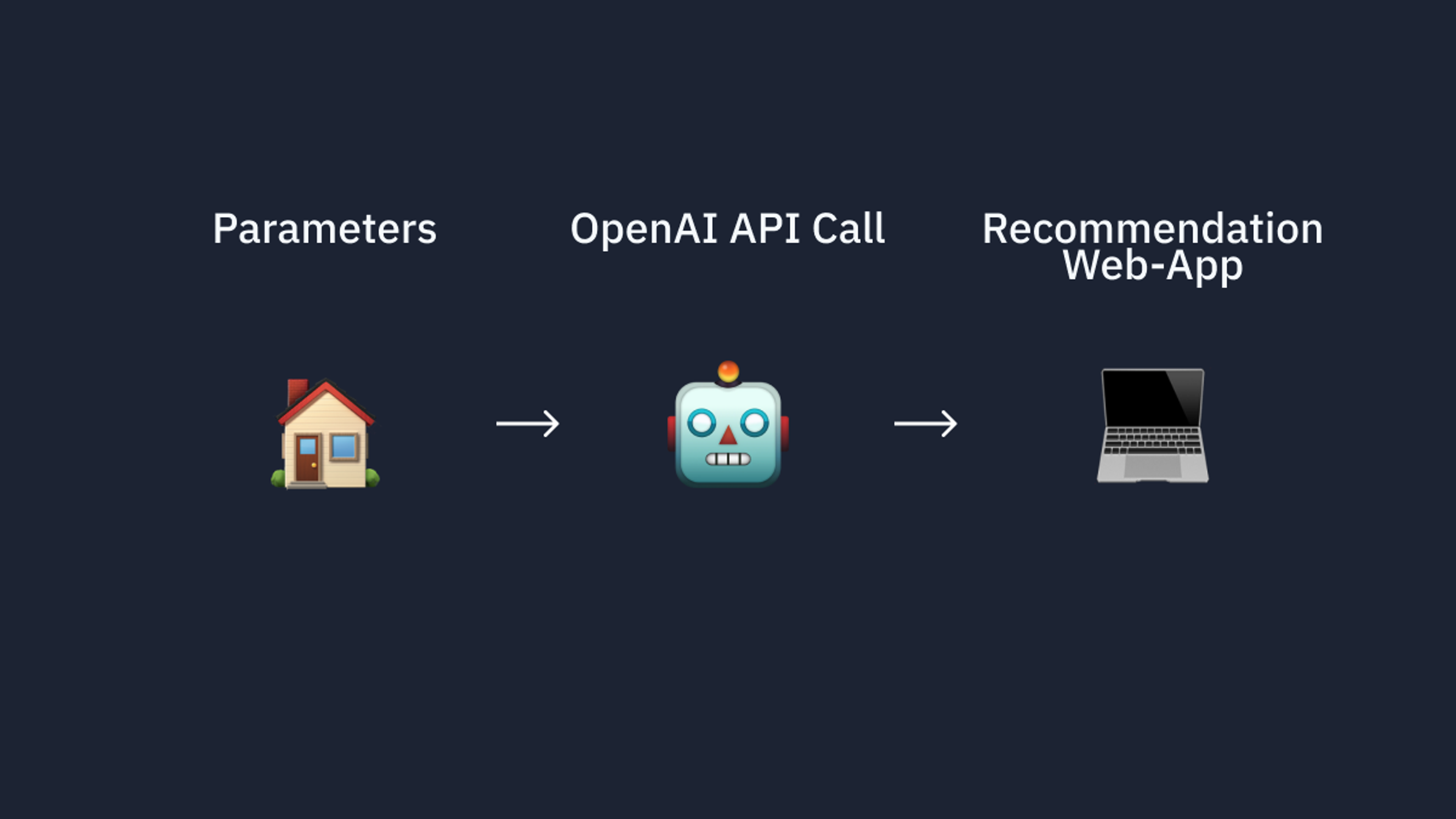
Problem Statement Christo Hefer is Founder and COO at Symplete, a real estate technology platform for agents to handle marketing and sales and help agents select the best purchase agreements for their listings. He wanted to create a prototype where a residential purchase agreement could be uploaded in PDF format and analyzed using OpenAI’s GPT-3 API. Based on 15-20 different fields as inputs, the best purchase agreement should be recommended to the agent. Building the Prototype To do this, the Bounty Hunter Syed (Repit username: cudanexus) used a Python Library to read the residential agreement PDF before sending it to GPT-3 to analyze. After that, he used the GPT-3 API to analyze the document and present the real estate agent with the optimal agreement for their listing. The parameters used included the address, price and offer expiry dates amongst others.