
Summary
- Manny (from Replit), and Cong & Denis (from Databricks) walked through our new Replit–Databricks connector, showing how we vibe coded enterprise data apps live.
- Databricks centralized enterprise data and AI for tens of thousands of customers, so our Replit apps could tap governed tables, models, and warehouses without copying sensitive data around.
- We used Replit’s Databricks connector to pull real sample datasets into an app, then let the agent vibe code a 3D weather globe that stayed safely inside Databricks.
- Replit Agent handled the scaffolding and UI while Databricks handled scale and governance, so Manny could ship a working data tool in minutes instead of weeks of traditional BI work.
- Databricks Genie acted as an in-app data copilot, answering natural-language questions with cited tables so builders saw exactly which data every insight came from.
- We framed this integration as vibe coding going pro inside enterprises, where PMs, RevOps, and analysts can ship governed data apps themselves instead of waiting in engineering queues.
In this livestream, we brought together Manny from Replit with Cong and Denis from Databricks to show what happens when you plug Replit’s agent directly into a governed data platform.
As a former data scientist, Manny walked through why vibe coding has already changed how people write software, and why the next frontier is letting data teams and business teams build on the same trusted Databricks datasets they already use.
Big takeaway: You can now vibe code governed and secure enterprise-grade apps simply by connecting Replit with Databricks.
The TLDW Highlights
Why vibe coding needs real enterprise data
“Vibe coding is allowing teams to ship more and to ship faster,” says Manny.
We see that every day with Replit: product managers prototype tools, RevOps spins up automations, and designers ship full websites without waiting in an engineering queue.
But inside enterprises, there’s a catch. The most valuable apps need real company context: sales pipelines, revenue data, support history, marketing performance, and more.
Those datasets are sensitive, live behind strict access controls, and usually sit in a central platform your data team manages.
That’s where traditional vibe coding has hit a wall. You can build great side projects, but if you want to touch actual production data, security and governance concerns step in fast.
What Databricks brings to our builders
Cong lays out what Databricks actually is in terms that matter to builders and data teams: “Databricks is an enterprise data and AI platform.”
More than twenty thousand enterprise customers, including a large share of the Fortune 500, already store and govern their data, models, and analytics in Databricks.
Databricks customers are using it in the following ways:
- Production tables and warehouses
- Machine learning models and vector indexes
- Dashboards and internal data products
From our perspective at Replit, Databricks is the place where your company’s trusted data and AI live. If you want a Replit app to actually matter to sales, finance, marketing, or ops, it needs to plug into that source of truth instead of a random CSV.
Cong framed the long-term vision this way:
“It should be as easy to build a custom app for your use case than it is now to create a slide.”
Databricks apps are that “slide,” but built on top of governed enterprise data and AI.
Connecting Replit to Databricks inside the IDE
Manny shows how simple it is to connect Replit to Databricks using our new connector.
Instead of spinning up infrastructure or managing credentials by hand, you:
- Add the Databricks connector in Replit.
- Authenticate against your Databricks workspace.
- Let Replit Agent discover available catalogs, schemas, and tables you can safely work with.
Once the connector is live, your Replit project can:
- Query Databricks tables directly from the app.
- Generate code that respects existing governance and access controls.
- Reuse models and AI endpoints your data team already maintains.
The key difference is that the app lives with the governed data instead of copying sensitive datasets into random side projects.
Vibe coding a 3D weather globe app
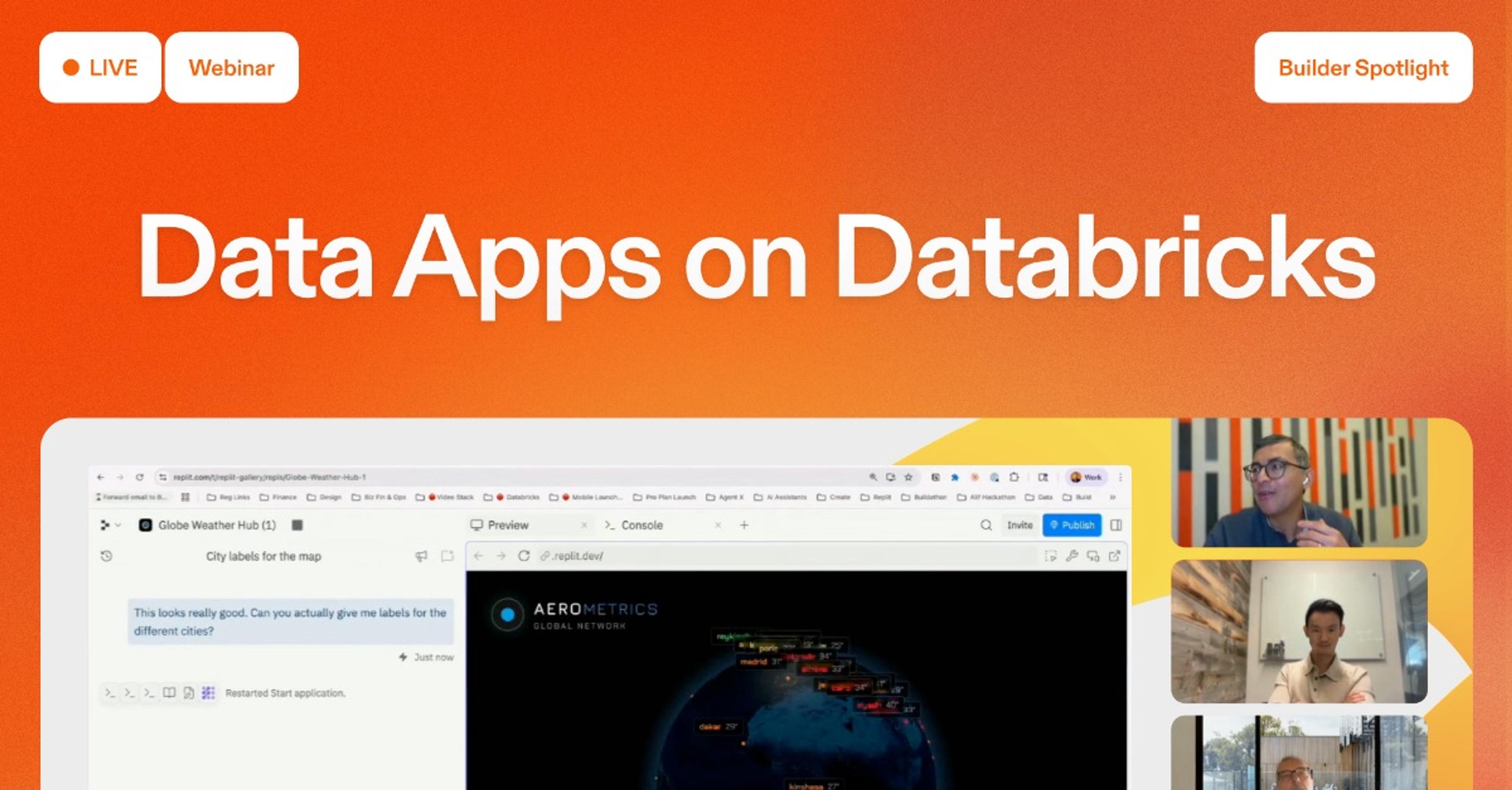
To make it concrete, Manny vibe coded a 3D weather globe using sample data from Databricks.
He started from a plain-language prompt in Replit describing the experience: a globe that visualizes weather across locations, powered by data from Databricks. The agent responded by scaffolding the project:
- Creating a basic frontend view for the globe.
- Wiring up calls to Databricks to fetch the sample datasets.
- Handling the data plumbing so the visualization could update as queries changed.
Instead of spending days stitching together a data pipeline, API layer, and frontend framework, Manny focused on tightening the prompt and editing the generated code. Replit Agent handled most of the scaffolding and UI boilerplate while Databricks handled data scale and governance.
The end result: a working, explorable globe app built in minutes on top of governed data. The kind of internal tool that would normally sit at the end of a long BI backlog.
Letting Genie answer questions with citations
The team also showed how Databricks Genie acts as an in-app data copilot.
Inside the Databricks environment, Genie can:
- Answer natural-language questions about your data.
- Point to the exact tables and fields backing every answer.
- Help builders understand which datasets to use before they ever write a query.
When you combine Genie with Replit, you get a loop where:
- Genie helps you find and understand the right tables.
- Replit’s Agent generates the code to query those tables and build the app.
- Both stay inside the same governed environment your data team already trusts.
That traceability matters when you’re shipping apps that will influence decisions in sales, finance, and operations. Builders can show exactly where a chart or recommendation came from without reverse-engineering someone else’s notebook.
What this means for data teams and builders
For data teams, the Replit–Databricks combo means more of the long tail of internal tools can be built without adding to an already full engineering backlog. Business stakeholders can ship their own governed apps while still leaning on Databricks for security, compliance, and performance.
For builders across the company—PMs, analysts, RevOps, marketers, and more—it means vibe coding can finally move past demos and side projects. With Replit plugged directly into Databricks, anyone who can prompt well can:
- Stand up dashboards on top of live, trusted tables.
- Build workflow tools that match how their team actually works.
- Iterate quickly without waiting weeks for a formal project to get staffed.
It’s the same creative, fast-moving energy people already love about Replit, now wired into the systems enterprises rely on to run the business.
AI disclaimer: This post was originally drafted using an AI-generated summary of a video transcript and subsequently reviewed and edited by a member of our content team for accuracy and clarity.